電動車專題|電動車需求衰退下車用科技發展核心(下)
作者:智璞產業趨勢研究所綠能中心主任 余適伯
Automotive lighting is expected to become the focus of technological upgrading, Lianjia Optoelectronics mastered the growth of the automotive industry three core
In the past few years, the automotive technology revolution led by electric vehicles has pushed the related industries to continue to progress, and after several years of technological baptism, the standardization of automotive technology has become one of the key considerations for consumers when purchasing a car. In the process of intellectualization, "intelligent cabin system" and "advanced driver assistance system (ADAS)" will become the twin engines of the automotive remembering evolution because they can be introduced into both electric and fuel vehicle (to satisfy the first core of "electric vehicle is not the only one") systems at the same time. The "Advanced Driver Assistance System (ADAS)" is based on safety as the main demand, and promotes the upgrading of components such as head-up displays, large touchscreens, autonomous driving, and directional vehicle lighting. In the smart cabin segment, the visual-oriented upgrades can best let consumers feel the product recognition, including entertainment-oriented car displays, interior ambient lighting, ambient lighting, etc. will become the next wave of key components to be upgraded. It is predicted that in the future, these two systems will continue to lead the advancement of automotive upgrades, and in these two systems, the intersection of the most automotive LED lighting will become the next focus of the industry, the current LED penetration rate in electric vehicles has exceeded 90%, but only accounted for 77% in fuel vehicles, the next five years in the automotive upgrades under the demand for fuel vehicles, the LED penetration rate will quickly catch up with the! In the next five years, under the demand of vehicle upgrade, the LED penetration rate of fuel vehicles will rapidly catch up with that of electric vehicles, and the market has room to grow up to 10 billion dollars.
Figure 6 Automotive Lighting Intelligent Revolution in Progress
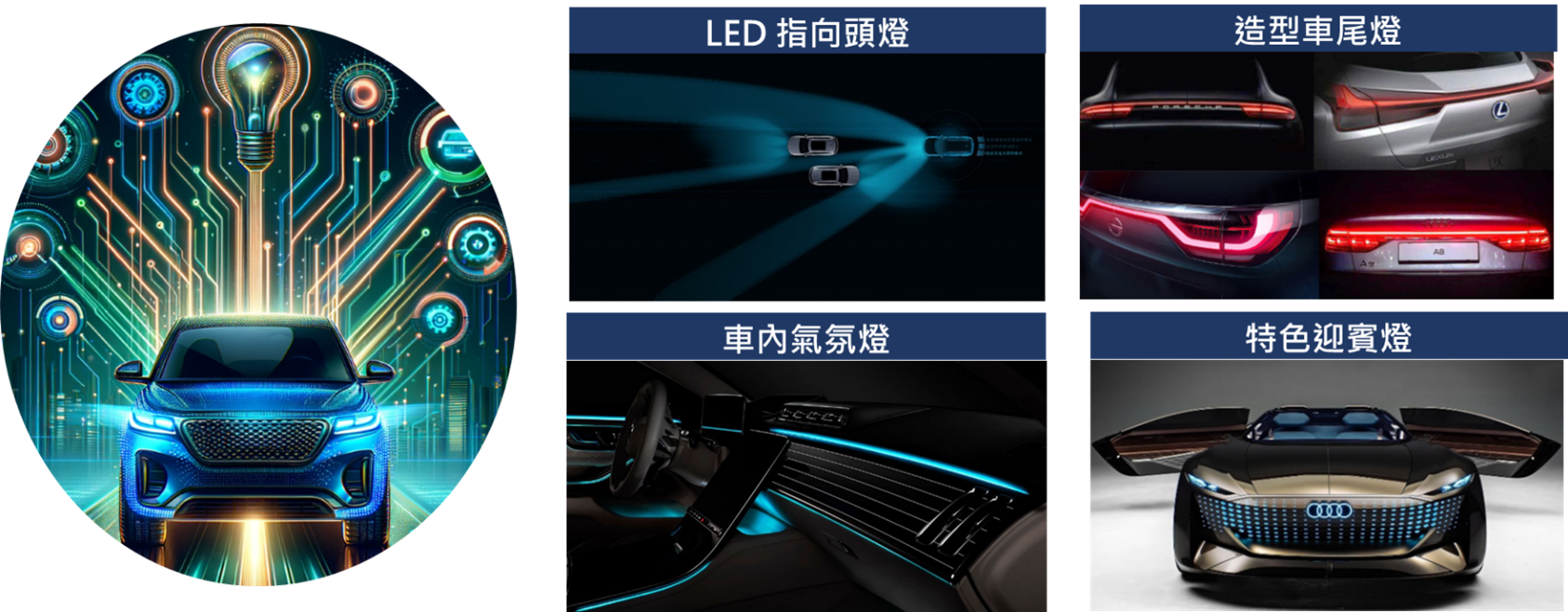
Source: Ji-Pu Industrial Trend Research Institute 2024/03
In the field of automotive LEDs, Taiwan's manufacturers, including Lianjia Optronics, have the conditions mentioned above to satisfy customers' "cost-oriented" pursuits and meet the "geopolitical factors" of regionalized production, and have the potential for growth. The company's main business for automotive LED components packaging, OEM / ODM of the LED module and light guide, LED traffic signals, etc. ... in the automotive lighting products for a long time, and most of the projects are directly with the original cooperation, in recent years the front-loaded market share has reached 95%. Lianjia relies on the long-term investment in LED R & D, the establishment of LED lighting products from the design, simulation, pilot production, mass production, testing, testing, and the development of the LED lighting products, the company has a long history in the automotive lighting products, and most of the project is direct cooperation with original equipment manufacturers, the front-loaded market share has reached 95%, Relying on our long-term investment in LED R&D, we have established a one-stop capability from design, simulation, pilot production, mass production, testing, validation, and logistics, which can help automotive manufacturers save costs and optimize overall production efficiency when upgrading automotive lighting. In addition, when electric vehicles brought about structural changes in the industry chain in the past few years, Lite-On has seized the opportunity to co-design with automobile manufacturers and become a preferred supplier for OEMs.
In terms of regional competition and production, Lian-Chia's current revenue share in North America is the highest at 76%, and in addition to the electric car brand Tesla, the partner factories include Ford, General Motors (GM), and Stellantis's vehicles, penetrating into the electric car and fuel car brand factories. The Michigan plant has contributed over $19 million in revenue annually, which has helped the company to sustain revenue growth in the face of slowing demand for electric vehicles and U.S. policy toward protecting local production. In addition to revenue growth, Lian-Chia is also committed to cost optimization. The new plant in Mexico, which the company has invested in, will open in 2024, integrating the labor and raw material costs of the Michigan plant and optimizing overall costs to further increase net profit margins by 4%~5%. On the other side of the ocean, Lian-Chia is optimistic about the rising demand for automotive technology from European carmakers and will promote product diversification by entering into a strategic partnership with a strategic partner in the Czech Republic. In 2024, Lian-Chia will promote product diversification, cooperate with strategic partners in the Czech Republic, and target German car makers as the main goal. Lian-Chia will use the new products of automotive control ECU components as the cornerstone of the product line extension program, and seek to increase the sales channels of high-margin products. Summarizing the above cases of Lianjia Optoelectronics, in the next few years, during the transition period when the sales growth of electric vehicles tends to stabilize, automotive technology will continue to develop, and the industry and related enterprises that have mastered the above mentioned three major cores are expected to become the main players in the next wave of revenue growth.