
September_ESG Strategy Topic|Necessity and Practice of ESG Sustainability
In 1979, Archie B. Carroll, a professor at the University of Georgia in the United States, proposed the concept of Corporate Social Responsibility (CSR) and divided corporate social responsibility into four levels, from bottom to top: economic responsibility, legal responsibility, ethical responsibility, and charitable responsibility. This concept was promoted by the then UN Secretary General, Kofi Anan, in 1999, and has gradually been emphasized by international corporations, and some companies have begun to publish annual Corporate Sustainability Reports (CSR) from their own perspectives. However, as CSR only suggests that in the process of growth, enterprises should take into account social responsibilities such as law-abiding, transparency, ethics, and giving back to the community, and is oriented towards the pursuit of goals, although there was already a preliminary concept at that time, there was no clear definition of the implementation details.
SDGs Relationship with ESG
In 2004, Kofi Anan, the Secretary General of the United Nations, presented the report "Who Cares Wins", in which he recommended that "Environment", "Social" and "Governance" should be included in the criteria for evaluating a company and be used as one of the reference criteria for investment activities, business and operation. ESG can be further subdivided into a number of executive cores (Figure 1), including "Climate Change", "Biodiversity", "Water Resources", and "Environmental Pollution" under "Environment"; "Customer Relations", "Employee Welfare", and "Diversity" under "Social"; and "Business Ethics" and "Financial Transparency" under "Corporate Governance", Business Ethics", "Financial Transparency", "Business Competition" and "Supply Chain Management".
Figure 1 ESG Investment Indicators
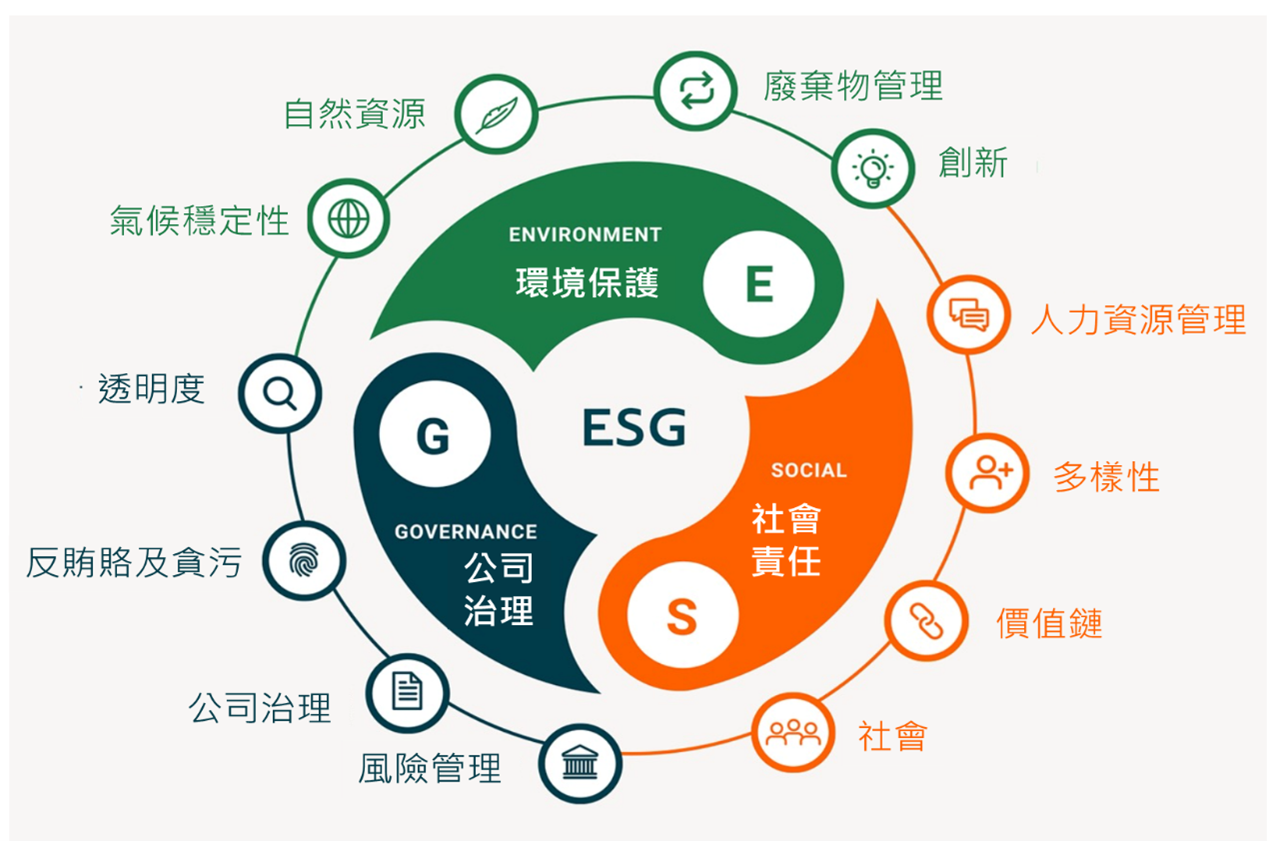
Source: Taiwan Environmental Culture and Education Foundation 2024/9
In 2006, a new organization, the United Nations Principles for Responsible Investment (UN PRI), was established to promote the six principles of the UN PRI: 1) inclusion of ESG in analysis and investment, 2) incorporation of ESG considerations by corporate shareholders in their stock strategies, 3) disclosure of ESG by investment targets, 4) efforts to promote acceptance and implementation of the UN PRI by the asset management industry, 5) cooperation to enhance the effectiveness of the implementation of the above principles, and 6) reporting on the status and progress of the implementation of the UN PRI. To promote the acceptance and implementation of UN PRIs by the asset management industry, 5. To improve the effectiveness of the implementation of the above principles through cooperation, and 6. To report on the status and progress of the implementation of UN PRIs. Since then, ESG investments have been attracting the attention of large global funds.
Nearly a decade after the launch of the UN PRI Principles for investing in and monitoring the implementation of ESG, in September 2015, all UN member states unanimously endorsed "Transforming Our World: The 2030 Agenda for Sustainable Development," which lists 17 key implementation goals for the SDGs (Figure 2) and 169 assessment indicators as the basis for national sustainable development implementation. The SDGs set out 17 key implementation targets (Figure 2) and 169 assessment indicators as the basis for the implementation of national sustainable development.
Figure 2: SDGs 17 Key Objectives
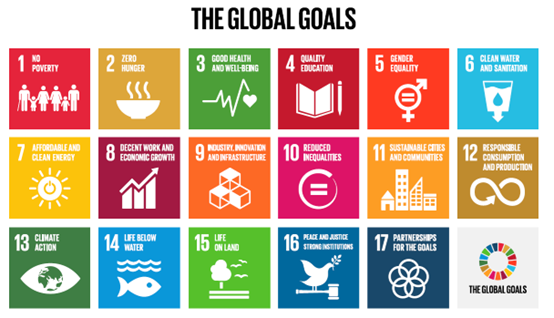
Source: Sustainable Development Goals website 2024/9
The 17 objectives can be categorized into four categories: development, economy, environment, and overall structure, and the goals set for countries at the time are beginning to be introduced by corporations as time goes by. From the above, it can be seen that although both are based on the perspective of sustainability, ESG focuses on the implementation, evaluation and business activities among corporate entities, investors and other stakeholders, whereas SDGs cover the sustainability blueprints and implementation details of countries, corporations and non-profit organizations around the globe. Although the impact objectives of the two sides are not the same, their ultimate goal is to pursue the interests of the present and the sustainable development of the next generation. Both sides are on the same path and their programs are complementary to each other. Therefore, the necessity of ESG implementation for enterprises can also be explained by the three major reasons for the implementation of SDGs.
Three reasons why companies should adopt SDGs as the core of their implementation towards successful ESG practices.
- Enterprises can achieve both profitability and sustainability according to the SDGs: In the book "The Sustainable Business Revolution 2030", the author mentions that in order to achieve the SDGs 12.3 target of "halving global per capita food waste", companies have to start from the supply chain, packaging technology, and sales system, and through these innovations and investments, they have to widen the gap between them and the companies that have not yet implemented the SDGs. Through these innovations and investments, Sun Micron will be able to close the gap with companies in the industrial chain that have not implemented SDGs and gain an edge over the competition. In addition, as can be seen from Sun Micron Holdings' 2022 Sustainability Report, the company has been investing for 10 years to improve energy efficiency "SDGs 7.3" by building light-off factories, introducing AI and 5G millimeter wave into factory operations, and promoting the fourth industrial revolution. In the end, the company has achieved a capacity increase of 67% and a shortened lead time of 37%, and has become a global model for semiconductor packaging in terms of energy efficiency and sustainable development, taking into account profitability on the way to realizing the SDGs.
- SDGs targets are expected to create new markets and promote overall industrial progress: When we look at the industry, the implementation of SDGs targets can even lead to the development of new market demands in related industries. The best example is the electric car wave led by Tesla in recent years, which has successfully driven the development of several automotive markets, including electric cars, batteries, autonomous driving, smart cabins, and automotive semiconductors. The "SDGs 13" climate action is the main theme, in which we can see that Tesla and other companies with foresight have brought great feedback from their early investment. We can also see that China's commitment to the electric vehicle industry has not only created a huge market in the field of electric vehicles, but also a complete industrial cluster in the field, which has made European and American traditional car makers fearful of it.
- In the process of globalized trade, the implementation of SDGs will become a must in the supply chain: as ESG issues have become one of the core pursuits of large corporations in Europe and the US in recent years, the importance of SDGs implementation in the B2B sales process is not limited to the company's own vision, but also comes from external customers' requirements, which have become the driving force behind the SDGs targets of the customers in the supply chain. For example, consumer electronics giant Apple has asked its supply chain to implement a decarbonization plan starting in 2020, and has set a goal of achieving a zero climate impact on every product it sells by 2030. It has even listed in detail that it will reduce its own carbon emissions by 751 TP3T, and that it will also introduce new technologies to remove carbon, in order to reduce the remaining 251 TP3T of its carbon footprint. Toyota, one of the leading automotive companies today, has also made a demand to reduce carbon dioxide emissions from new vehicles by 90% by 2050, to reduce carbon neutrality throughout the entire lifecycle from basic materials, parts and components, to the assembly line, as well as to reduce zero carbon emissions from factories around the world. Enterprises in the supply chain need to satisfy customers' SDGs target demands in order to have the opportunity to introduce their products into the supply chain, and this kind of pressure from end-brand customers will become an important driving force for enterprises to implement SDGs.
Four Steps to Tackle Sustainability Implementation
When implementing ESGs or SDGs, one of the most common situations that companies encounter is that they don't know what to do. Although the SDGs have clearly set out 17 goals and 169 implementation details, when there are too many ingredients in the basket, the chef will not know which dish to choose. Not to mention the fact that although ESG is driven by enterprises, the core of its implementation is more generalized than that of SDGs, leaving enterprises that want to move towards sustainable development at a loss. In order to solve this problem, four major steps are proposed for enterprises: "top-down", "prioritization", "goal-setting", and "continuous tracking of results".
- Top-down: The most common conflict that arises when a company starts to implement a sustainability program is "Why do it? The most common conflict that arises when starting a sustainability program is "why do it?", as employees in a company are seeking to maximize the company's profits, and the economic results of ESGs or SDGs are not readily achievable, these tasks are placed at the back of the list in the course of a busy day's work. This highlights the importance of SDGs 4.7 sustainability education. The best solution to avoid this situation is for companies to start at the top when promulgating sustainability tasks. The board of directors should lead senior executives to set up a sustainability department, and the chairman of the board of directors should preside over every meeting. The Board of Directors should lead the company's senior executives to establish a sustainability department where the Chairman of the Board personally chairs each meeting.
- Identify priorities: After confirming the structure of the sustainability association, the next problem is how to find the goals. Although the ESG has suggested that companies should move towards three major directions, namely "Environmental", "Social" and "Governance", and has listed the general implementation goals, it is still not easy to choose. It is recommended to refer to the 17 goals and 169 implementation details of the SDGs, and select the priority items related to the company's operation based on the needs of its customers. For example, if Apple requires its products to achieve net zero carbon emissions by 2030, then companies in the supply chain should prioritize this item. In addition, if a company's main production expenditure is on labor-intensive technology operations, it can evaluate its diversity and implement SDGs 5.1. In addition to customer demand as a starting point, it is also necessary to examine its own supply chain, starting from the production (or service) side, and prioritize the implementation of projects that can best enhance external ESG benefits and reduce internal costs. The evaluation method is based on the company's "relevance", "impact on operations", and "ESG evaluation" in order of priority.
- Detailed goal-setting: After the priority items are clearly defined, it is time for detailed goal-setting, and in order to conduct reasonable evaluation after the implementation, it is necessary to list the goals and KPIs for the detailed items, and the three major elements of "clarity", "enforceability" and "sustainability" should be considered in the process of goal-setting. Specificity refers to the fact that objectives should be formulated based on the current situation of the company, so that corresponding objectives can be given according to the current conditions; otherwise, it is easy to set an objective that has already been accomplished. Otherwise, it is easy to set a goal that has already been accomplished. Executability is to consider the existing internal and external resources to make a reasonable goal setting. Sustainability requires the setting of targets that can be tracked over the long term. For example, if a company's use of green electricity (SDGs 7.2) is above a certain level, this target should be tracked over the long term and included in the sustainability report. For example, if the company is to implement SDGs 5.1 and increase the equal rights of women on the production line, the target is to increase the proportion of female supervisors in technical operations to 30% within 2 years, and this target is to be tracked and included in the Sustainability Report.
- Continuous tracking of results: After setting up detailed goals and KPIs, list out the tracking schedule of each item and report to the sustainability committee periodically to discuss the progress and problems encountered in the implementation. The committee and the chairman should do continuous tracking and communication for each goal, and output the sustainability report with a yearly cycle, track the sustainability horizontally every year, and track whether each task has been accomplished vertically in depth, and whether goals are set too simply. If the objectives are set too simple, etc., the company will continue to track the sustainability report on a yearly basis.
In recent years, due to the rising awareness of net-zero carbon emissions, companies often prioritize carbon reduction when talking about sustainability. It is recommended that when implementing sustainability, in addition to the four major steps for setting sustainability goals, attention should also be paid to the internal and external aspects, such as the implementation of "employee welfare" and "diversification" in the "social" aspect, as well as the "business competition" and "supply chain management" in the "corporate management" aspect.
 July_Carbon Pricing|Cost Impact of Carbon Levy and Policy Direction
 October_Electric Vehicle Feature|10/10 Will Robotaxi bring a new wave of Tesla?