Industry Trend Report|Energy Storage Technology and Lithium Ion Battery Future Direction
Energy storage is the process of converting electricity into other forms of energy and storing them in a physical system, and then releasing them when needed. At present, many kinds of energy storage technologies have been developed, which can be categorized into three main types according to the energy conversion method, such as "physical", "electromagnetic" and "electrochemical", and the characteristics of each technology are listed in Table 1. Pumped hydro is one of the "physical" types of energy storage, and is currently the most mature and lowest-cost energy storage technology; since the first pumped hydro station was set up in Zurich, Switzerland in 1882, there has been more than a hundred years of application history. It must be set up in a location with an abundant and stable supply of water, but in recent years a number of new reservoirs facing ecological and environmental controversies and has been shelved, resulting in the global pumped storage power storage facilities since 2016, the volume of construction has only grown by 0.6%, compared to the annual growth rate of global power storage facilities reached 9%, pumped storage power, although it still accounts for the highest proportion of power storage, but the market share has been declining year by year, and the share of the first time in 2021 will be lower than the proportion of the first time. In 2021, the share of pumped storage power will be lower than 90% for the first time.
表一、主要儲能技術比較表

資料來源:Applied Energy;智璞產業趨勢研究所整理2022/08
受益全球能源轉型,鋰電池是當前市場擴張最快的儲能技術
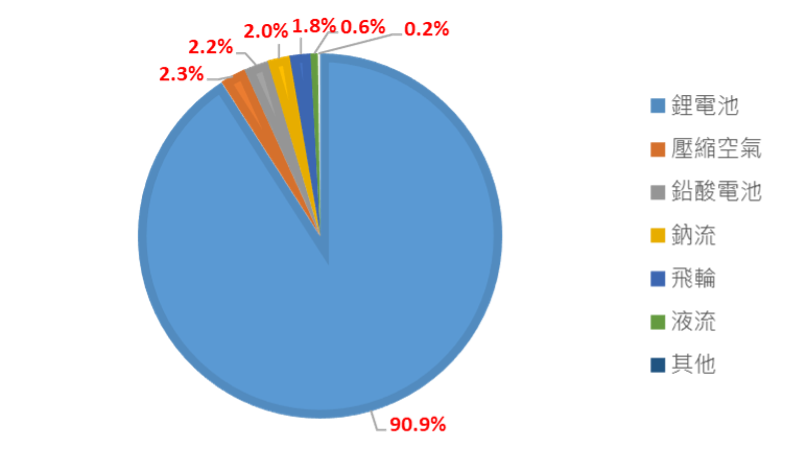
根據中國大陸CNESA發布的《2022儲能產業研究白皮書》指出,截至2021年底,新型儲能技術累計裝置量為25.4 GW,年增67.7%,其中以鋰電池市占率達90.9%為最高,其次是壓縮空氣的2.3%與鉛酸電池的2.2%,如圖二所示,顯示鋰電池是當前市場擴張最快的儲能技術。2021年全球新增運轉的儲能系統裝置量達18.3 GW,年增185%,其中新型儲能技術占10.2 GW,是2020年的2.2倍。
圖一、2021年全球新型儲能累積安裝量之占比(總量209.4 GW)
資料來源:CNESA;智璞產業趨勢研究所整理2022/08
使用壽命、能量密度與成本將成為鋰電池未來發展重點
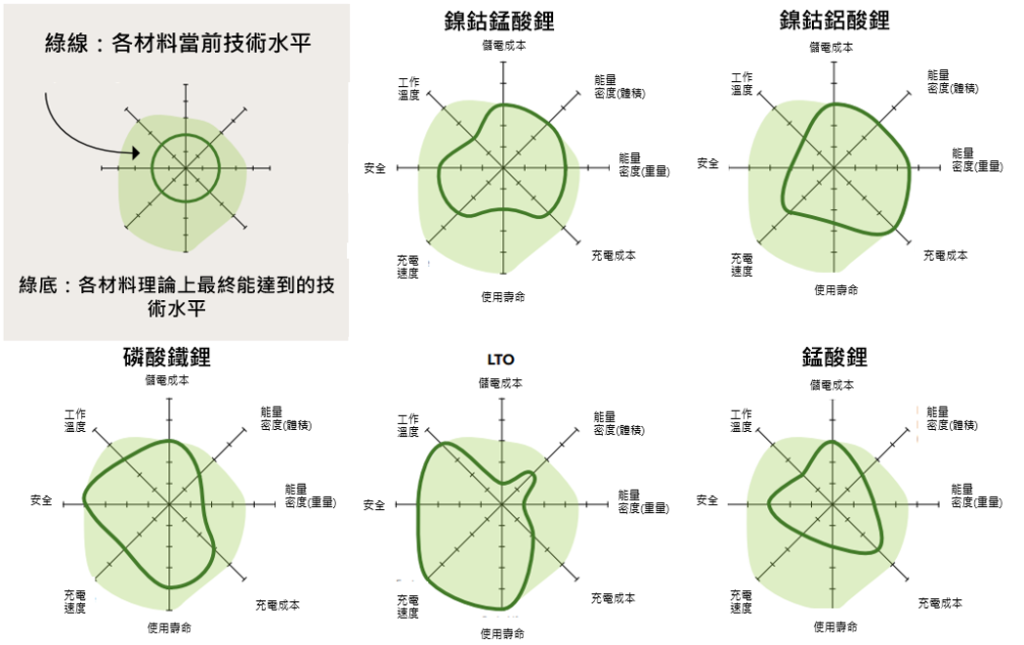
鋰離子電池正極是鋰與不同金屬的複合氧化物,如磷酸鐵鋰(LFP),鈦酸鋰(LTO),錳酸鋰(LMO),鈷酸鋰(LCO)、鎳鈷錳酸鋰(NMC)、鎳鈷鋁酸鋰(NCA)等,負極材料主要為石墨或鈦酸鋰,電解質使用LiPF6、Li[N(CF3SO2)2]等鋰鹽有機溶液。表一顯示各類鋰電池主要應用領域與代表性製造商。因使用正極材料不同,在不考慮電池系統設計影像下,成本、體積能量密度、重量能量密度、充放電速率、充放電循環使用壽命、安全性、可使用溫度區間各有優劣勢(圖二為各類鋰電池性能比較)。。在眾多材料中以磷酸鐵鋰、鈦酸鋰兩種電池使用壽命較長,而鎳鈷錳酸鋰and鎳鈷鋁酸鋰電池優點是能量密度較高,且能利用量產技術降低成本,目前分別為製造商技術研發重心,預計將在未來脫穎而出成為主要材料The
圖二、各類鋰電池性能比較
資料來源:Breakthrough Batteries-Powering the Era of Clean Electrification;智璞產業趨勢研究所整理2022/08
表二、各類鋰電池主要應用領域與代表性製造商

資料來源:Breakthrough Batteries-Powering the Era of Clean Electrification;智璞產業趨勢研究所整理2022/08
-For more information, please clickContact Us -
 Industry Trend Report|Global Battery Storage Manufacturer Development Trend
 Industry Trend Report|Lithium Batteries Drive Global Energy Storage Development