
矽光子專題|全球矽光子市場概況分析(下)
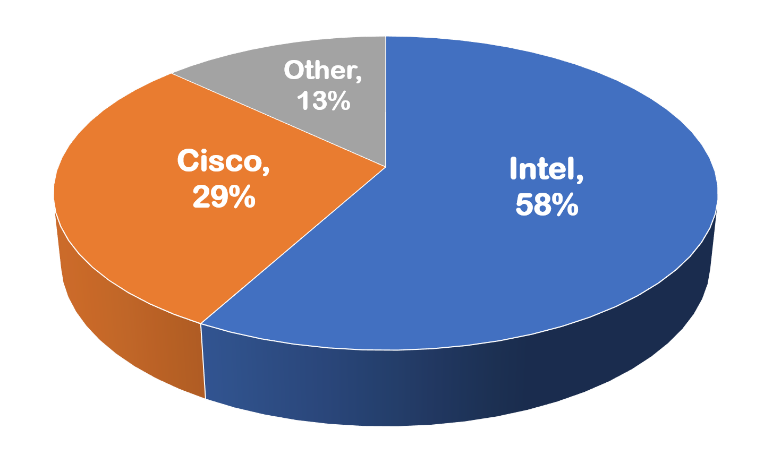
According to a report published by Yole Développement in 2022, the global silicon photonics market is expected to grow from $151 million in 2021 to $927 million in 2027, with a CAGR of 36%. Intel is the market leader, with a 58% market share; Intel is the market leader with a market share of 581 TP3T; Cisco, which has acquired Lightwire, Luxtera, and Acacia, is the second largest with a market share of 291 TP3T; and the rest are smaller companies, as shown in Figure 2.
Figure 2: Global Silicon Photonics Market Share by Vendors
Source : Organized by Ji-Pu Industrial Trend Research Institute, 2023/09
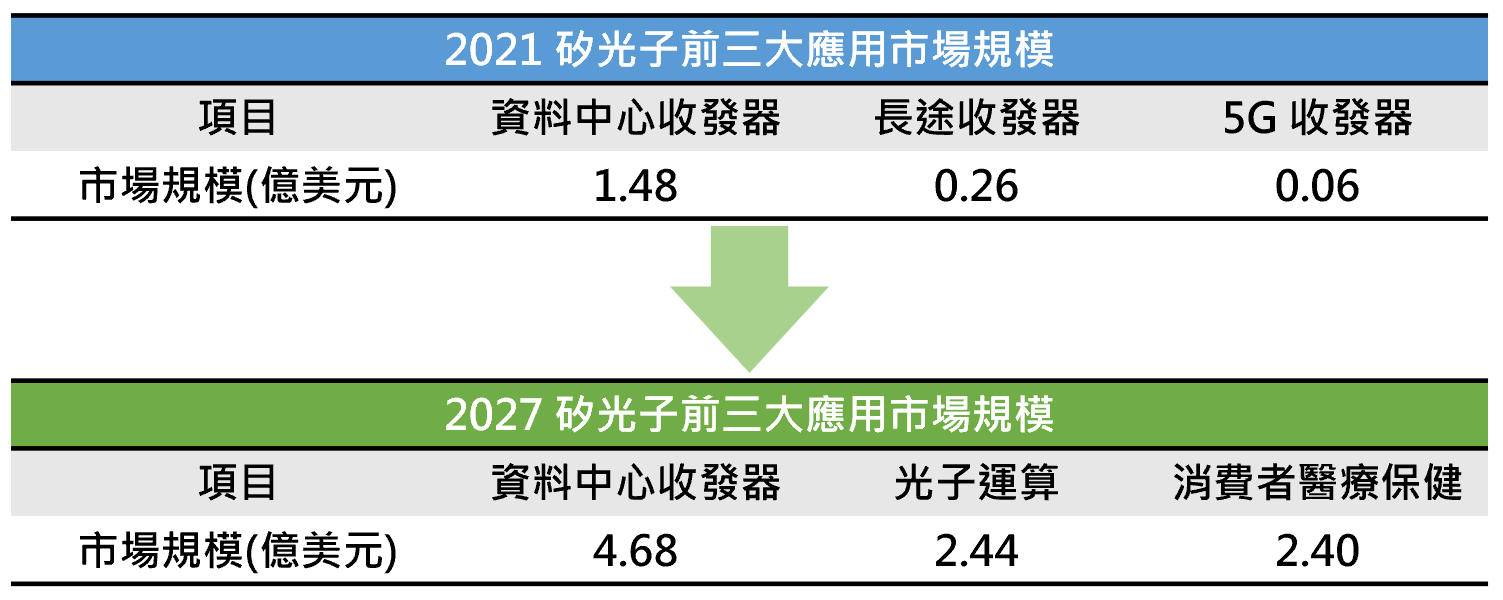
In terms of applications, silicon photonics technology covers the fields of data computing, transmission and sensing. As shown in Table 1, the top three applications in order of market size in 2021 are transceivers for data centers, long distance, and 5G, and the top three applications by 2027 are expected to be transceivers for data centers, photonic computing, and consumer healthcare.
Table 1, 2021, 2027 Changes in Top Three Market Applications
Source : Yole Développement (2022); Organized by Ji-Pu Industrial Trend Research Institute, 2023/09
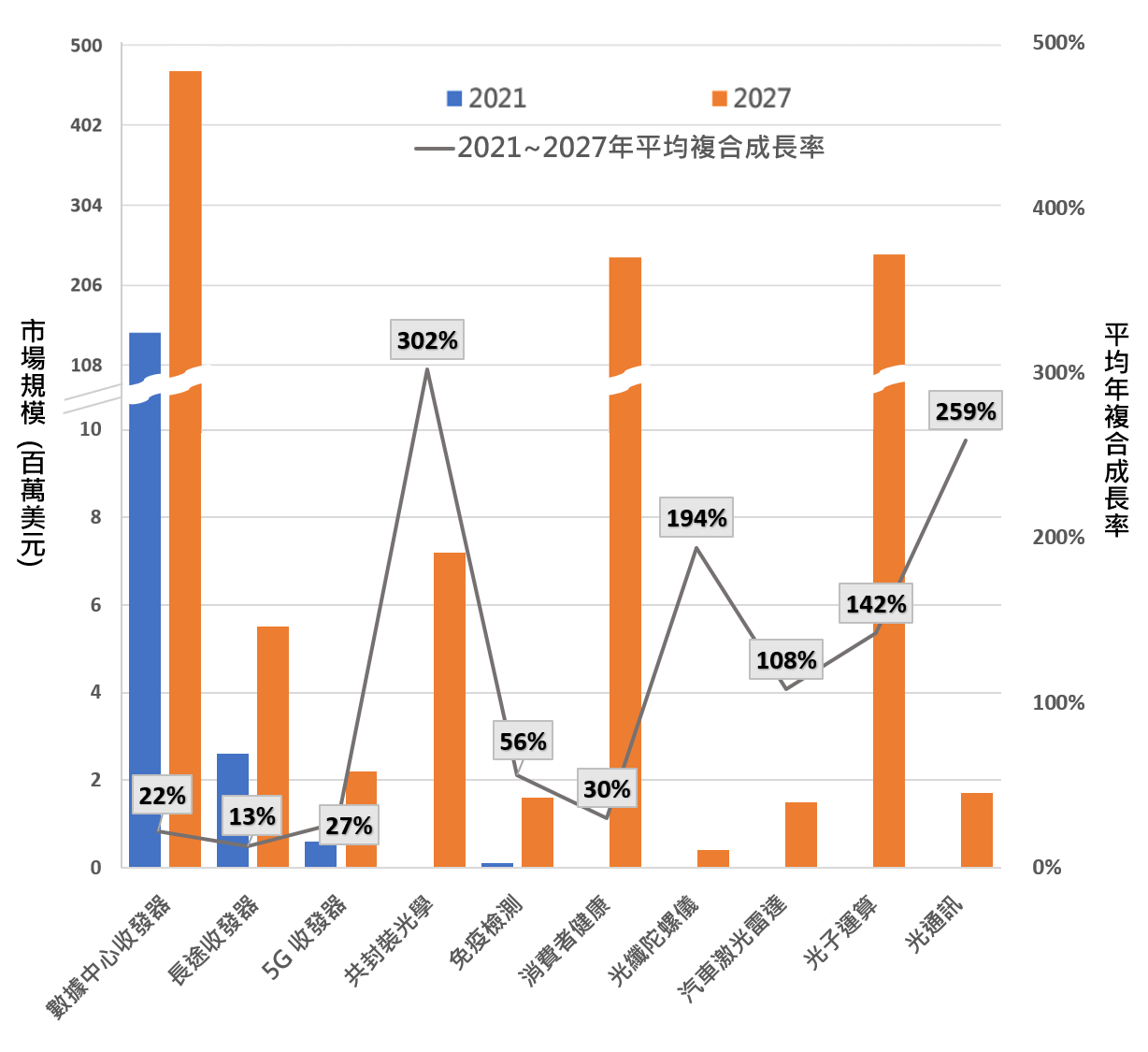
The top three applications with the best growth rates areCo-packed Optical,Optical CommunicationandFiber Optic GyroscopeThe average annual composite growth rate [2021~2027] is 302%, 259% and 194% respectively, as shown in Fig. 3, and the important applications are described as follows.
Figure 3: Silicon Photonics Application Market Size Change, 2021, 2027
Source : Yole Développement (2022); Organized by Ji-Pu Industrial Trend Research Institute, 2023/09
- Information Center : In recent years, in order to cope with the huge amount of data traffic, the network deployment of data centers must be rapidly upgraded. Since the bandwidth provided by copper cables no longer meets the demand, fiber-optic Ethernet and silicon photonics fiber transceivers, mainly provided by Intel and Cisco, have been rapidly introduced to help quickly convert optical signals into electronic signals to increase the data transmission rate and extend the transmission distance. According to the data released by Equnix, the annual compound growth rate of the global Internet bandwidth capacity from 2017 to 2021 reached 48%, and the network switches will enter the 400Gbps era from 2020, when copper cables can still be used for transmission. However, after entering the 800Gbps era in 2022, the signal degradation will occur with the copper transmission, and optical fiber communication will be gradually adopted. Benefiting from the development of silicon photonics technology, market research firm Gartner estimates that the proportion of silicon photonics switch products in data center communication channels will increase from less than 5% in 2020 to more than 20% in 2025.
- 5GCommunications : In the past, 4G LTE base station signals could enter indoors directly, but 5G millimeter-wave signals have poorer penetration and are prone to poor indoor reception. Optical microwave systems can be used to extend signals to indoor areas to solve this problem, and the use of fiber optic transmission can provide the larger signal bandwidth and data transmission required by 5G networks. Silicon photonics optical millimeter-wave antenna modules with integrated silicon photonics chips, RF chips, and phase-array antennas have the advantages of small size and low power consumption, which are favorable for large-scale indoor installations.
- photonic computing : It is a computer that carries out data computation, logical operation, information storage and processing by optical signals. It is composed of laser and reflector, lens, filter and other optical components, relying on laser beams into the reflector and lens array for information processing, in addition to ultra-high computing speed and the human brain similar fault tolerance, when a component of the system is damaged or error will not affect the final calculation results. Lightmatter, an independent startup from MIT, has launched a photonic processor consisting of two vertically stacked chips, a 12 nm ASIC at the top and a 90 nm optical computing chip at the bottom, both manufactured by GlobalFoundries. The company claims that the chip is 20 times more power efficient and handles 5 times more information than the Nvidia A100 when running the BERT and Resnet-50 models, respectively.
- Healthcare : Silicon photonics technology integrates various photonic and electronic functions into a single chip to produce cheaper, faster and more energy-efficient medical devices, so that people can be checked at home when they feel sick, and then go to the hospital for treatment if necessary. For example, Apple has developed a silicon photonic glucose detection technology, which uses laser light to irradiate tissues under the skin and detects reflected light not absorbed by glucose to analyze its concentration; Surfix Diagnostics has developed a silicon photonic biosensor, which can detect a variety of biological features for diagnosis and treatment.
- KWANGDA(LiDAR). Highly accurate optical sensors are the key to the development of autonomous vehicles. The mainstream technology is the direct time-of-flight (dToF) system, which measures the time it takes for a laser pulse to reach the target and return to the sensor to calculate the distance to the target object, and can detect multiple objects. The second technology is the indirect time-of-flight (iToF) system, which also uses laser light waves to detect objects, but calculates the distance to the target object based on the phase difference between the waveforms of the emitted and received light, and can only detect a single object, with higher accuracy for indoor environments. The third is the FMCW (Frequency Modulated Continuous Wave) system, which uses tunable lasers to generate continuous light waves to continuously emit signals of increasing density and then calculate the distance to the target object by calculating the phase shift between round trips of light, and the process of converting the optical signal to a telecommunication signal uses silicon photonics technology, which is advantageous in terms of both excellent distance measurement performance and the ability to capture directional velocity information, and the ability to detect a single object.The popularization of silicon photonics technology will help address the high cost drawback and give it a chance to replace the mainstream direct time-of-flight technologyThe