Industry Trend Report|See how exosome makers are planning their development by deploying new highlights ahead of time
High Technical Barrier for Exosomes for Medical Use
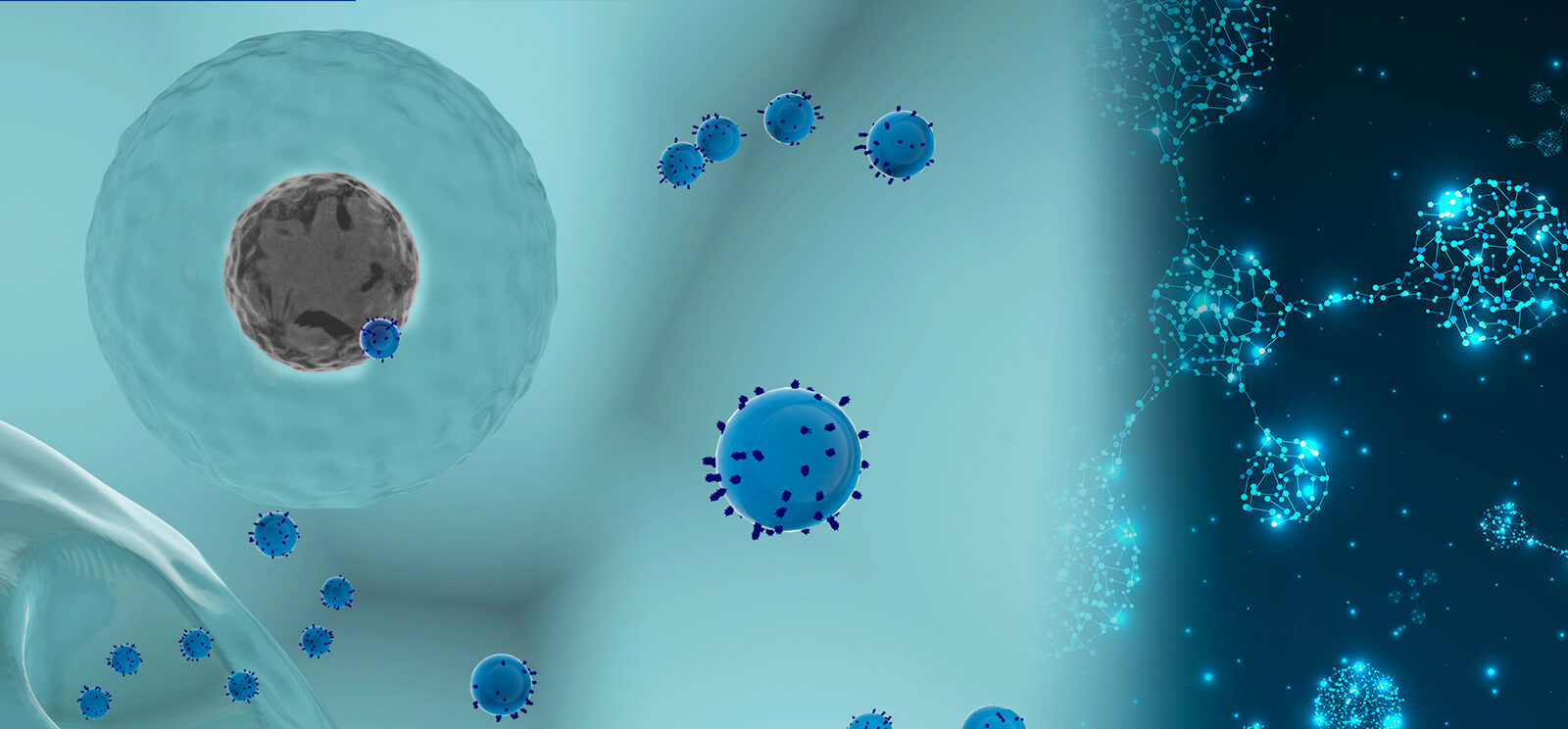
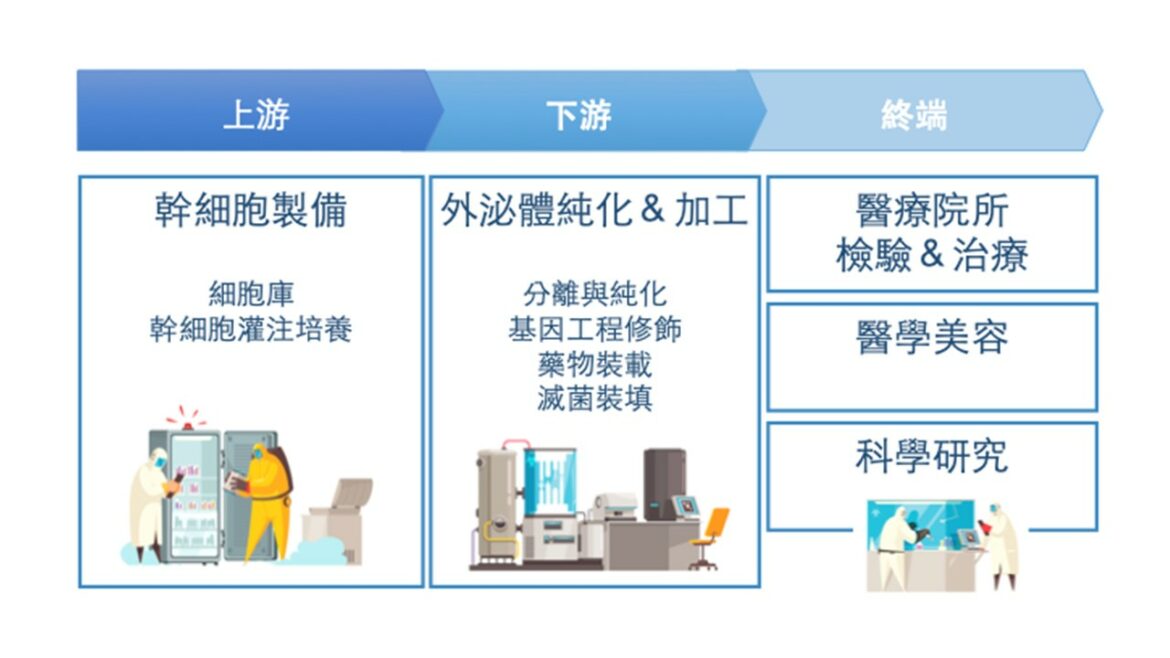
The exosome drug industry chain roughly overlaps with that of biologics/cell therapy contract development manufacturing services (CDMO) vendors, and the demand for talent is similar. In the early stages of drug development, specific types of stem cells are selected from upstream cell banks, their exosome targets and suitable protein scaffolds are identified, active ingredients are selected, and the loading process is confirmed to be feasible and effective before entering the production stage. After mass infusion of cultured stem cells in the factory, the exosomes will be separated, purified and genetically engineered for modification, and then loaded with suitable nucleic acids/antibodies/small molecules using electroporation and other techniques, and then cultured and processed again and tested for quality, and then made into cryopreserved crystals or other dosage forms before they can be turned into therapeutic drugs (Fig. 1). After entering the production stage, it is the most difficult patented technology to break through the production scale-up to be able to control the environmental parameters and produce large quantities of exosomes with stable quality and high purity for specific applications. The feasibility of purification by centrifugation is higher in the market, but the efficiency, recovery rate, and purity are relatively low, which is unsuitable for large-scale production; obtaining exosomes from magnetic beads coated with exosome surface markers to capture antibodies and purifying them by photoluminescence or microfluidic lysis is a newer technology. The purification of exosomes by light or microfluidic cleavage is a newer technology. In addition, drug loading involves surface protein scaffold modification engineering and transfection technology, as well as the cost and time spent on clinical trials of new drugs for different indications, all of which are technically difficult and have a long research period, and must pay attention to the high-precision and high-threshold industries with patent protection.
Figure 1: Overview of exosome processing flow
Multinational pharmaceutical company alliance to obtain R&D and manufacturing production capital.
Currently, there are about 55 companies in the global exosome pharmaceutical industry, with one-third of them focusing on testing business and the other two-thirds on developing new drugs for different diseases. Companies with larger financing amounts and greater scale and visibility include:
Bio-Techne's ExosomeDx
Founded in 2008 in the United States, the company was acquired by Bio-Techne in 2018 for a total price of $575 million to develop the world's first liquid biopsy exosome merchandise, and in 2019 ExoDx, a liquid biopsy merchandise for prostate cancer, was the first to be approved by the FDA as a breakthrough medical material. The company owns 250 patents, and its diagnostic products division brings in $274 million in revenue, with a growth rate of 21% in mid-2022, and its ExoDx product is still growing over 10% in its third year on the market, and its assay has reached record highs, demonstrating high market acceptance. 2022, the company will collaborate with biotech genetic testing superstar Thermo Fisher Science to develop a kidney cancer exosome. In 2022, we will collaborate with Thermo Fisher Science, a leading biotech genetic testing company, to develop an exosome biopsy product for kidney cancer.
Codiak BioSciences
Founded in 2015 in the U.S. and listed on Nasdaq in October 2020, has raised US$700 million. Owns natural exosome mass production manufacturing and loading technology, develops PTGFRN and BASP1 as exosome internal and external linking protein scaffolds. It also possesses chromatography and filtration technologies that replace the traditional ultracentrifugation method, which have significantly improved the production efficiency and purity of exosomes. With a focus on cancer applications, its engEx drug carrier platform for cutaneous T-cell lymphoma is also in clinical trials. 1 billion strategic commercialization agreement with Ireland's Jazz Pharmaceuticals in 2019 to develop therapeutic solutions for five cancers, and collaborations with gene therapy companies such as Sarepta and Dyno Therapeutics. 2021 Sale In 2021, we sold our cGMP exosome manufacturing plant to our partner Lonza, a Swiss pharmaceutical company, but retained our cancer drug R&D. We have recently reissued shares to raise capital, and we have recently reorganized our R&D pipeline by suspending two Phase II studies and focusing on the Phase I trial of exoASO-STAT6. Revenue for the past year was $34.7 million.
Evox Therapeutics (United Kingdom)
Founded in 2016 at the University of Oxford, UK, the company has raised US$500 million to develop its patented Deliver EX exosome drug platform, which engineers and loads natural exosomes with protein modifications and nucleic acids to deliver proteins, and currently owns a total of 81 patents in Europe, the U.S., and Japan, with a focus on rare diseases and central nervous system of the brain. 2020 is the year of cooperation with Takeda Pharmaceuticals in the development of technology for rare diseases and with Lilly in the research and development of neurodegenerative diseases, respectively. In 2020, we will collaborate with Takeda Pharmaceuticals on rare disease technology and Lilly Pharmaceuticals on neurodegenerative diseases.
Pharmaceutical start-up exosome maker makes progress in new coronary pneumonia treatment and rare diseases
In contrast to exosome R&D companies with large financing and both manufacturing and R&D functions, start-ups with limited capital have chosen to enter with new drugs for the treatment of neococcal pneumonia and rare diseases in order to make rapid progress. Exosome-related clinical trials are relatively advanced, including Capricor, Direct Biologics, Vitti, and Organicell, which have conducted Phase I to Phase III clinical trials for the treatment of pneumonia caused by neococcal pneumonia. Capricor's CAP-1002, which uses exosomes from heart cells to treat the rare disease of muscular dystrophy, Duchenne muscular dystrophy (DMD), has been the first to obtain FDA approval as an orphan drug and is in phase III clinical trials. Aegle Therapeutics' AGLE-102, a new drug for children with rare skin diseases, has also obtained its first exosome clinical IND for a Phase IIa trial in 2020.
Korea FactoryExoCoBioExosome Technology for Medical Products930$10,000 in financing
Founded in 2017, ExoCoBio is the world's fourth largest exosome producer, and has raised US$1.68 billion in successive capital raisings. In August 2021, it will build a new GMP plant specialized in the production of exosomes, which is expected to be completed by the end of 2022. It owns the patented technology of ExoSCRT exosome, and produces the patented exosome extracted from mesenchymal stem cells, which is not only used to research and develop anti-inflammatory skin medicines, but also put into production of a wide range of nutritional products from 2018, including hair growth and sensitive skin cosmetic to the medical aesthetic pathway, as well as developing exosome medicines. In addition to the development of anti-inflammatory skin medicines based on ASC-Exosome, the company has also started to produce a variety of skin care products since 2018, including hair growth and sensitive skin cosmetics to medical aesthetics, as well as the development of exosome drugs.
台廠積極整備迎接再生醫療三法元年
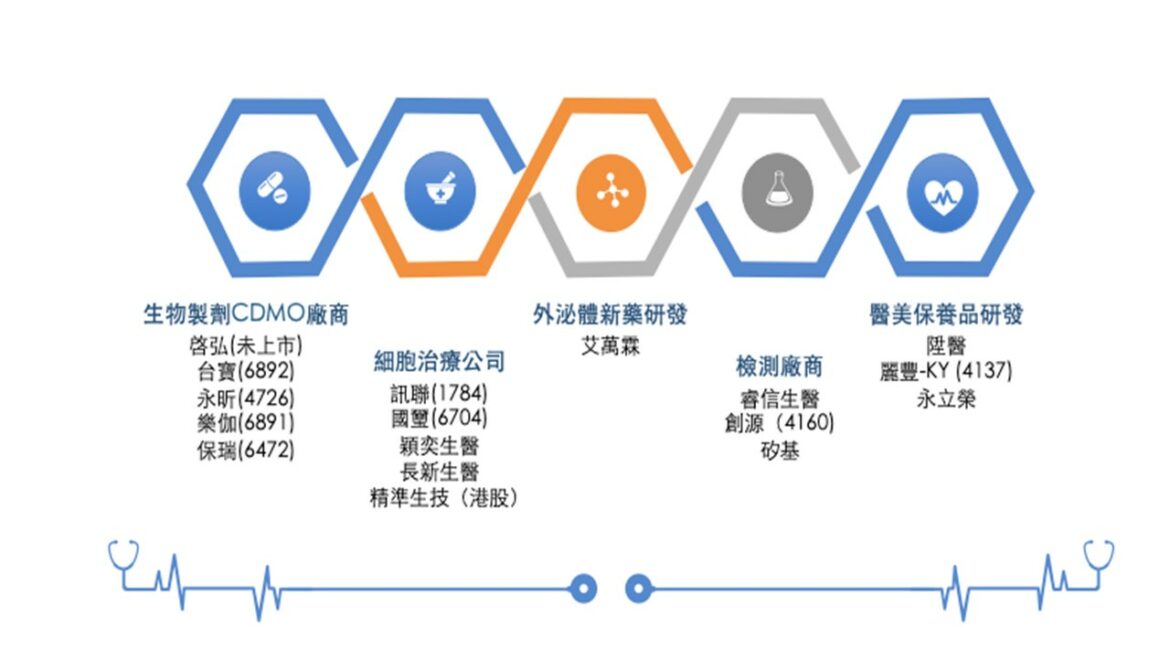
台廠在多年來的政策積極鼓勵下,在竹北、南港、南科的國家隊產業聚落逐漸成形,在去年通過的生技醫藥產業發展條例以及立法院審議中的再生醫療三法將胞器納入立法範圍的政策加持後,外泌體接力細胞治療與抗體偶聯藥物ADC等新興生物藥題材,成為台廠新的關注投資焦點,投資的廠商以生產大分子藥及生物製劑的CDMO廠商,和具擁有幹細胞庫,具有細胞治療製備經驗的廠商較有綜效誘因(圖二)。技術門檻高的生物製劑CDMO生產代工佈局,透過資本的協助紛紛擴建廠房,在抗體藥物與病毒載體等新興生物藥研發和製造生產跟上國際製造標準,取得代工的門檻產能。在美國拜登政府簽署行政命令支持美國生技產業,引發中國大廠藥明康德可能的轉單效應,以及再生醫療三法修法利多後,或可近一步提供更大的成長空間。相較於外廠對於突破性新藥及新檢測診斷技術的研發取向,台灣專研發外泌體新藥搶攻first-in-class的廠商雖寥寥可數,但在外廠外泌體藥物開發及臨床試驗量能進度均有限的情況下,借鑑韓廠從醫美保養品切入點亦是另種策略。
圖二、外泌體相關台廠
訊聯(1784)
經營臍帶間質幹細胞(MSC)庫業務已20年的訊聯,在以往特管辦法時代即已累積國內最多自體脂肪幹細胞治療慢性傷口的細胞治療案例,嫻熟各種細胞製備。子公司創源(4160)能提供外泌體的檢測一條龍服務,今年五月再成立子公司「訊聯細胞智藥」,主攻細胞治療及外泌體新藥,已有符合歐盟化妝品GMP製造規範廠房認證,今年亦取得整年度委託代工醫美訂單。挾有華人最大的間質幹細胞庫的優勢,轉型至細胞治療領域表現亦佳,公司策略持續投入間質幹細胞3D大規模擴產製程開發的研究,已取得品質好的幹細胞,近期轉型CDMO研發幹細胞新藥及衍伸物外泌體醫美保養品。
永昕(4726)
2001年即由晟德大藥廠投資創立,2022年日本藥廠JCR Pharmaceutical 入股為最大股東,2019年開始轉型為全台首家CDMO公司,在新興生物藥領域發展積極,包括抗體偶聯藥物ADC、異體細胞治療及外泌體領域有藥物設計、製程開發與放大的能力,年初啟用的cGMP工廠二廠及預計2024年落成的三廠,預計2023及2024年將取得美歐日的查廠認證,新興生物藥的營收占比約5~10%,近五年營收逐步成長,近年經營日本客戶有成,客戶中已有兩項藥品進入臨床三期。
台寶(6892)
成立於2014年,由高端轉投資,今年9月興櫃,雙軌主攻異體細胞非腫瘤新藥開發及CDMO,擁有全台首座PIC/S GMP細胞治療製備工廠12條產線,運用「低氧誘導平台」、「細胞功能分析平台」、「細胞修飾平台」與「基因載體平台」等四大獨特專利技術平台SuperCarrier,開發多樣細胞醫療產品。目前有四項新藥開發中,其中治療關節炎的異體間質幹細胞治療及治療下肢缺血傷口癒合的產品(Chondrochymal、Biochymal)已進入臨床試驗IIb期,預計明年申請FDA 第一期臨床試驗許可。目前已與艾萬霖合作,著手開發外泌體細胞庫,成為外泌體新藥研發的上游細胞製備及製程開發供應商。
艾萬霖生技(未上市)
由前衛福部長林奏延成立於2020年底的艾萬霖公司,是台灣首個專注於外泌體新藥及產品開發的公司,由東洋藥品及醫新生科投資,2022年初與台寶生醫簽約CDMO,由台寶提供細胞庫及製程優化,艾萬霖進行新藥研發。目前已完成間質幹細胞2.5D大量培養製程及外泌體純化鑑定專利和凍晶保存技術,同時開發外泌體數量及分析平台和藥效平台。目前在顆粒數、濃度及純度均優於國際水平。目前著重於臍帶間質幹細胞外泌體的開發,今年第一項適應症漸凍症的新藥,是台灣首個外泌體新藥指標案件,未來將主攻慢性阻塞性肺病(COPD)及神經退化性疾病,目前已有四項研發中的產品,同時預計於2023年推出抗老醫美產品。
啓弘(未上市)
2016年創立的啓弘是台灣首家以生物製劑及品管檢測為主的CRO公司,前身為財團法人生物技術開發中心下的生技藥品檢驗中心,亦獲台康生技及台杉等入股投資,是台灣唯一的GMP生物製劑安全確校檢測服務商,亞洲少數具有臨床等級病毒載體製造GMP工廠的公司(另兩家為中國藥明康德與日本Takara Bio),擁有P2+實驗室和GLP認證,可提供細胞、病毒細菌及動物試驗一站式服務,具有亞洲領先技術優勢。近期完成6億元A輪增資擴產第二條病毒載體生產線,預計2025年可投產擠身CDMO商之列,2020年已損益兩平。由於具有先進製程及細胞治療的開發能力並佔有細胞產品檢測供應鏈的重要地位,後續潛力可期。
累積研發能量,準備產能基礎建設等候外泌體市場發酵
外泌體藥物的發展空間雖大,但從國內外研發進度看來,由於不同細胞所分泌的外泌體均不同,標靶運作的機制和生物工程等基礎研究,以及對特定疾病的作用機轉,仍需要時間的累積,即使在研發最快的美國,外泌體的相關品質審查亦尚未有統一的標準和共識,能夠進入臨床的藥品和檢測商品仍很少,難以表現在財報營收上。但從跨國藥廠商投入資源的程度來看,相當近似於早期的抗體偶聯藥物,早期佈局仍有其必要。新興生物藥的投資無法一步到位,仍需透過新興細胞療法持續投資專業人才及科研練功,等候進一步發酵。
-For more information, please clickContact Us -
 Industry Trend Report|New Drugs: Exosome Development Opportunities
 January_CES Feature|CES2023 Digital Health Development, Look at the Future of Innovation and Change