Industry Trend Report|Global Semiconductor 2022 Review and 2023 Outlook (Up)
A look back at the global semiconductor market to 2022
COVID-19 epidemic in 2020 ravaged the world, infectious and high lethality caused panic, in order to control the epidemic, the governments of various countries have adopted varying degrees of lockdown measures, requiring people to work at home and distance learning, thus driving the demand for personal computers, tablets, and other electronic products, making the global semiconductor market is not affected by the epidemic hit by the economic impact of the decline, according to the World Semiconductor Trade Statistics (WSTS) released information, the global semiconductor market size in 2020 is estimated to reach $ 440.4 billion, a growth of 6.81% in 2020, a yearly growth of $ 4.8 billion. According to the World Semiconductor Trade Statistics (WSTS), the global semiconductor market is expected to reach US$440.4 billion in 2020, with an annual growth of 6.8%. 2021, although the COVID-19 outbreak has not improved significantly, the emergence of mutated viruses has reduced the lethality rate and continues to be the most important factor in the development of the global semiconductor market. The embargo has caused a public backlash against economic development, which has led governments to loosen regulatory measures, thereby stimulating economic recovery and boosting consumer spending. The semiconductor market has seen a huge increase in demand for remote devices due to the 2020 chain closure; downstream manufacturers are stocking up in advance and increasing inventories, resulting in constant congestion in wafer manufacturing; the long whip effect in the automotive market has resulted in a global shortage of automotive wafers, which has been accompanied by pressure from the governments of the U.S. and Europe, forcing wafer makers to increase their production; and finally, the risk-averse mentality of the ICT industry has resulted in an over-ordering and duplication of orders, which has led to an active shift in the supply chain to wafers in the global electronics industry. The supply chain of the electronics industry has been actively placing orders with foundries, resulting in continued full capacity and the highest growth rate in the global semiconductor market since 2011.
2021年市場規模達5,509億美元,年增25.1%。由於晶片保持強勁需求,2022年8月該機構預估2022年全球半導體市場規模達6,332億美元,年成長率為13.9%,但2023年增長率將顯著下滑至4.6%,全球市場規模則為6,624億美元。其將區域市場統計資料分成亞太、美洲、歐洲、日本等四部分。由於涵蓋台灣、韓國、中國等半導體重要產地,亞太地區已是全球最大半導體區域市場,2021年市場規模約達3,430億美元,預估2022年與2023年將持續增長至3,788、3,965億美元,2021至2023年成長率依序為26.5%、10.5%、4.7%。第二大區域市場是美洲,2021年市場規模約達1,215億美元,預估2022與2023年將持續增長至1,501、1,573億美元,2021至2023年成長率依序為27.4%、23.5%、4.8%;第三大區域市場是歐洲,2021年市場規模約達476億美元,預估2022年與2023年將持續增長至545、562億美元,2021至2023年成長率依序為27.3%、14.5%、3.2%。2021年日本市場規模約達437億美元,預估2022年與2023年將持續增長至545、562億美元,2021至2023年成長率依序為27.3%、14.5%、3.2%。整體來看,各區域市場都呈現規模持續增加、但成長率呈現下滑的趨勢。
其將產品市場統計資料分成積體電路、離散元件、光電元件、感測器等四部分。積體電路是市場規模最大的半導體產品,2021年銷售額為4,630億美元,預估2022與2023年將持續增長至5,340、5,594億美元,2021至2023年成長率依序為28.2%、15.3%、4.8%。市場規模第二大的半導體產品是光電元件,2021年銷售額為434億美元,預估2022與2023年將持續增長至435、451億美元,2021至2023年成長率依序為7.4%、0.2%、3.7%。離散元件是市場規模第三大的半導體產品,2021年銷售額為303億美元,預估2022與2023年將持續增長至334、347億美元,2021至2023年成長率依序為27.4%、10.1%、3.8%。2021年市場規模最小的感測器之銷售額為191億美元,預估2022與2023年將持續增長至223、232億美元,2021至2023年成長率依序為28.0%、16.6%、3.9%。整體來看,各種市場估算資料都呈現銷售額持續增加、但成長率逐年下滑的趨勢。
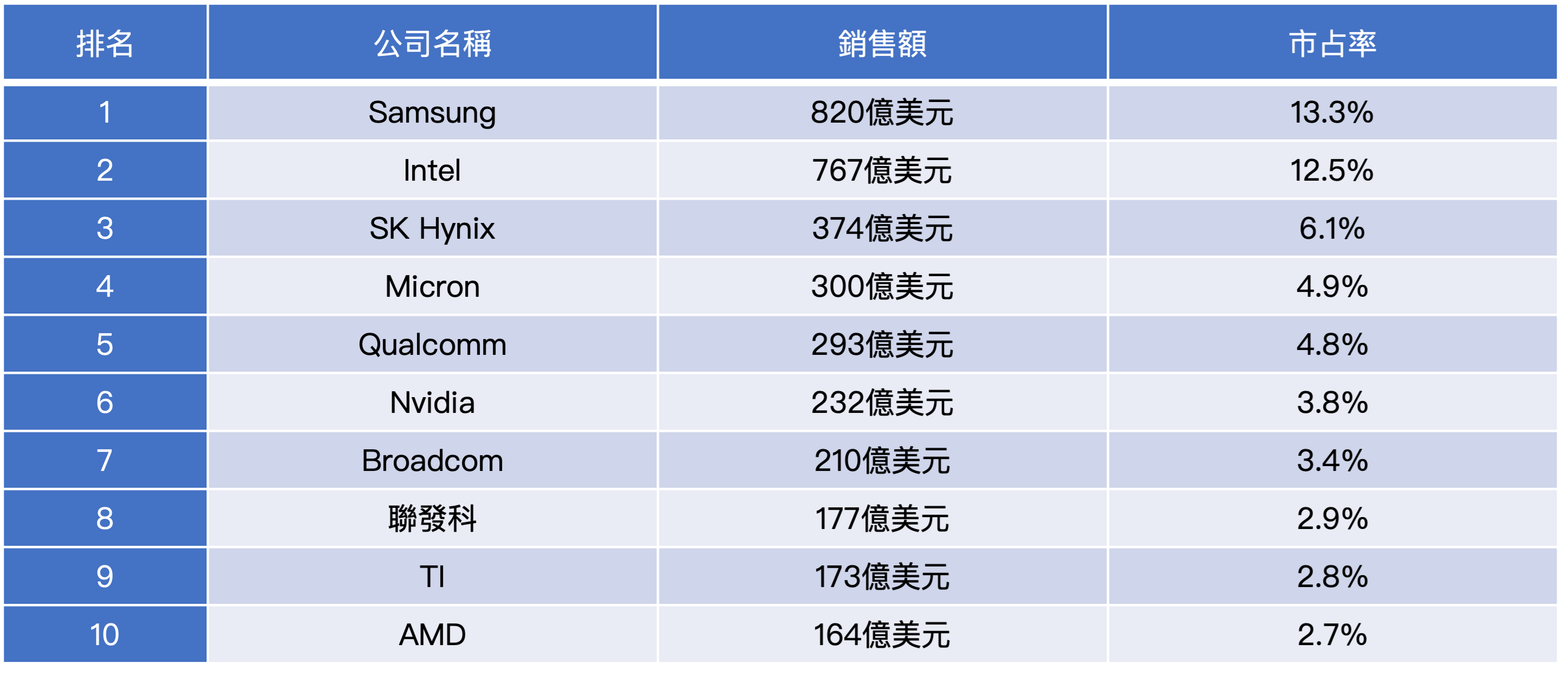
市場研究機構IC Insights發布的最新報告指出,2021年全球半導體市場規模為6,140億美元,年增21%,其中積體電路占5,098億美元,而光電、感測和離散元件共占1,042億美元。預估2022年主要半導體產品銷售將放緩,所以全球半導體市場規模將達6,807億美元,年增11%。其中積體電路占5,671億美元,而光電、感測和離散元件共占1,136億美元。2021年全球前十大晶片供應商名單如1所列,前五家公司依序為Samsung、Intel、SK Hynix、Micron、Qualcomm。先前Intel持續位居全球第一大晶片供應商,不過因為中央處理器市場被AMD大幅侵蝕,導致2021年被Samsung取代而落居第2名。該名單中新增聯發科、AMD等兩家公司,前者2021年營收大增61%,使得名次自第11名上升至第8名;後者2021年營收暴增68%,讓名次自第14名上升至第10名。2021年不含晶圓代工廠的前50家晶片供應商總銷售額占全球半導體市場比例達到89%,比2010年提升8%。其中前十大晶片供應商的市場占比則達到57%,全球前五大晶片供應商的總銷售額占整體市場規模的42%,預估市場集中度將持續上升。
表1、2021年全球前十大晶片供應商名單
資料來源 : IC Insights;智璞產業趨勢研究所整理
2022年全球半導體產業榮景由盛事轉為趨緩
市場研究機構Gartner發布的最新報告指出,因為COVID-19疫情引發的宅經濟需求持續發酵,使得3C電子產品銷量持續創高,加上5G通訊、電動車等新科技市場規模不斷擴大等有利因素促使2021年全球半導體產值暴增至達5,950億美元,年成長率高達26.3%,一掃2019年衰退11.3%的陰霾。然而2022年日益嚴重通貨膨脹引發物價高漲,導致一般民眾縮減非必要民生支出,估計智慧型手機、個人電腦銷售額將分別衰退3.5%與8.2%,此舉造成全球半導體市場逐步進入衰退期,預估2022年與個人電腦、智慧型手機有關的半導體產品銷售額成長率將縮減至5.4%與3.1%,而2022年全球半導體產值將小幅成長至6,392億美元,年增7.4%,遠低第一季預測的13.6%。這種衰退狀況將持續到2023年,所幸還有資料中心、汽車等終端應用市場維持擴張狀況,讓全球半導體產值僅年減2.5%,達到6,231億美元。
根據市場研究機構IDC最新報告資料,挺過2019年減12%的衰退期,2020年爆發的COVID-19疫情為全球半導體產業迎來一波需求成長期,至2021年達到最高點,此時全球半導體產值為5,820億美元,年成長達17.3%,主要驅動力來自於工業和汽車業,分別年增30.2%和26.7%,其他需求上升的應用還有5G手機、遊戲機、無線網路、資料中心和穿戴式裝置,雖然這些應用在2022年將繼續成長,不過預期第四季消費市場開始降溫,所以全球半導體產值成長率將下滑至13.7%,達到6,610億美元。考量近幾年新建產線將陸續於2022年底投產,故預期2023年半導體產業會因產能過剩而陷入衰退,主要衝擊成熟製程業務。
下一篇:Intel與全球重點IC大廠2022年上半年表現與下半年展望 (下)
-For more information, please clickContact Us -
 Industry Trend Report|Intel and Global Key IC Manufacturers 2022 H1 Performance and H2 Outlook (Next)
 Industry Trend Report|Global Semiconductor 2022 Review and 2023 Outlook (Chinese)