
March_Smart Capsule Chipset Topics|Global Smart Capsule SoC Chipset Supplier Product Technology Analysis(Part2)
- Intel : In 2016, the Atom processor for personal computers was expanded to the smart cockpit field with the launch of the A3930, A3940, A3950, A3960 and other A3900 series of main control SOC chips, followed by the launch of the A3920 in 2017 to expand the lower-end market, which has a performance similar to that of the flagship A3960, but at the lowest price, and has still been adopted by automobile manufacturers, although it has not yet obtained AEC-Q100 certification. Although it has not obtained AEC-Q100 certification, it is still used by automobile manufacturers. Although it is a 4-core chip with weaker performance, it has the advantage of supporting ACRN virtualization host, so it is adopted by many car makers, and currently ranks third in market share. However, no new products have been introduced since then, so most of the new cars of the customers have switched to cooperate with Qualcomm.
Table 3: Technical specifications of Intel's three main control SOC chips.
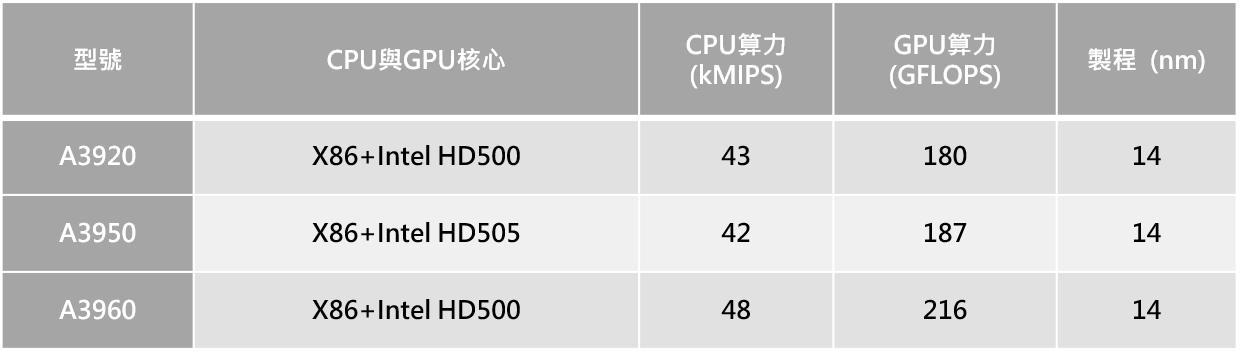
Source : Intel; Collated by Chipotle Industry Trends Research Institute, 2024/03
- NXP: The iMX series of products monopolizes the market for automotive infotainment chips, of which only the iMX8 series includes a master SOC chip for the smart cabin. The iMX8QM is the highest-end product, which adopts a hardware isolation design to ensure that sub-systems using different operating systems can operate normally. However, its Cortex-A72 architecture and 28nm process are lagging behind its competitors, and the delay in launching the next generation of its products has caused it to lose its competitiveness in the market.
- TI: has developed a series of automotive processors called Jacinto, divided into two categories: TDAx and DRAx. The former is used in ADAS and autonomous driving, and the latter is a smart cabin that supports in-vehicle infotainment, digital instrumentation, multiple operating systems, voice recognition and control, and high-performance graphic displays, etc. Jacinto 6, launched in 2013, has the DRA74x, DRA72x, DRA71x and other high, medium and low-level products. The Jacinto 6, launched in 2013, has high, medium and low end products such as DRA74x, DRA72x, DRA71x, etc. After that, the next generation Jacinto 7 series will be introduced to the market as late as 2020. Because of the long gap between the old and new products, Jacinto 6 was unable to meet customers' needs, resulting in a rapid shrinkage of its market share, so it abandoned the smart cabin market when Jacinto 7 was launched and only sold TDAx products.
- Samsung: Automotive processor products include Exynos Auto V for in-vehicle infotainment or smart cabin systems, Exynos Auto A for advanced driver assistance systems, Exynos Auto T for remote information processing, etc. Exynos Auto V has launched Exynos Auto 8890, Exynos Auto V7, Exynos Auto V9 and Exynos Auto V920, etc. Exynos Auto V920 is the latest flagship chip in the market, Exynos Auto V9 and Exynos Auto V920 are the latest flagship chipsets in the market, with technology derived from the Exynos 2200, which has significantly improved computing power compared to its predecessor.
Table 4: Technical specifications of Samsung's three main control SOC chips.
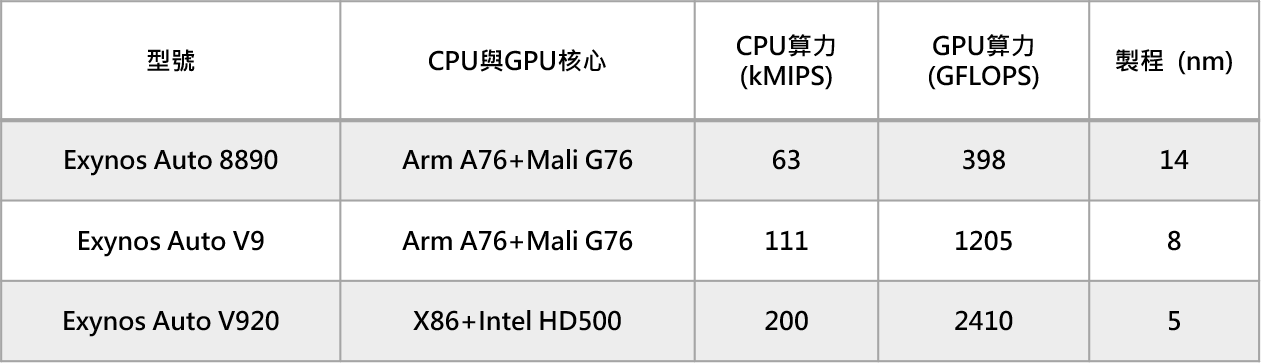
Source : Samsung ; Collated by Ji-Pu Industrial Trend Research Institute, 2024/03
Taiwan's automotive market is small, and car manufacturers almost directly import foreign models to assemble and sell in Taiwan, resulting in a lack of autonomy due to technology constraints from foreign mother plants. Therefore, there is little domestic demand for smart cabins, and domestic system vendors are cooperating with foreign chip vendors to enter the overseas market.
- UNIDENTIFIED MALE
MediaTek is the only SOC chip maker in China that has invested in the development of smart cabin SOC chips. They have started to develop automotive chips since 2016, and will launch the Yellow Mountain Project in 2021 to actively penetrate into the automotive market, which will be divided into four major product lines, including in-vehicle information and communication systems, smart cabin systems, millimeter-wave radar solutions, and visual advanced driver assistance systems. In the smart cockpit segment, the earliest MT2712 is a 6-core processor, which has been adopted by Volkswagen, Hyundai, and Audi, as well as Harman, LG Electronics, and Visteon, etc. The third-generation master SOC chip launched by Qualcomm, SA6155P, has average performance, while SA8155P is too expensive. SA8155P is too expensive, so MediaTek launched MT8666 to fill the gap between the two, its technology is derived from Helio P70, for the integration of Bluetooth, FM radio, WLAN and GPS module 8-core processor, but also for the SA8155P, SA8195P launched 8-core MT8192, MT8195, the former equipped with a 2.4 TOPS operation. In March 2023, the company announced that it will change the name of its automotive chipset series to Tianji Auto and will launch its flagship chipset integrating autonomous driving and smart cabin functions using 3nm process. In March 2023, the company announced to change the name of its automotive SOC series to Tianji Auto, and to launch a flagship SOC product integrating autonomous driving and smart cabin functions using 3nm process, and at the end of the same year, the company announced to collaborate with Nvidia to develop a new generation of smart cabin products with Nvidia's GPU microchip, and in 2024, the company announced to launch four smart cabin SOCs, namely, CX-1, CY-1, CM-1, and CV-1, which support Nvidia's Drive OS, to satisfy the needs of low-, medium-, and high-end cars. These chips are designed to meet the needs of low-, mid-, and high-end vehicles. In the past, MediaTek's chips did not have to pay 4G patent fees, and the supporting software licenses were cheaper. In addition, the performance difference with competitors' products would not be too big, thus competing with Qualcomm in the market with a high price-performance ratio.
Table 5: MediaTek's Master SOC Chip Product Specifications
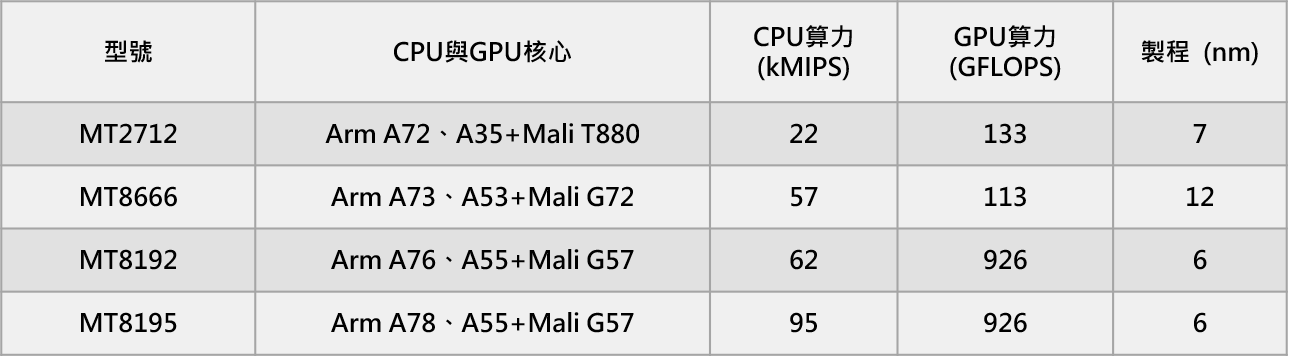
Source : MediaTek; Organized by Ji-Pu Industrial Trend Research Institute, 2024/03
- TSMC
In order to strengthen market competitiveness, some of the smart cockpit master SOC chip vendors are actively introducing advanced manufacturing processes. Chip designers such as Qualcomm and MediaTek need to outsource manufacturing, and TSMC is the only foundry in China that can undertake this task, and it is already one of the world's leading automotive SiS ecosystems. The most advanced process for mass production is the AEC-Q100 and ISO 26262 certified 5nm automotive (N5A) technology, which has been used to produce the Qualcomm SA8295P. In addition, Qualcomm's SA6155P, SA8155P, and SA8195P, as well as MediaTek's MT8192, and MT8195, are produced using its 6/7nm process. TSMC's automotive electronics business will account for 6% of TSMC's revenue in 2023. 6% is one of TSMC's key development projects, as it is a small business, but its revenue is still growing despite the uncertainty of the economic climate. 2023 will see the launch of the Auto Early platform, which will allow customers to design their automotive ICs in advance of the maturity of the manufacturing process in order to shorten the time to market, and TSMC's 3nm automotive (N3A) technology is expected to be ready for mass production by the time its process is perfected in 2025.
- Global Sun Electronics [Sun Micron's Electronic Manufacturing Service Provider].
Packaging and testing major Sunrise Investment Control is also actively laying out the smart cabin business, under the Sunrise Electronics is working with the main control SOC chip vendors to develop specialized system-in-package (SiP) technology, which can provide one-stop service from the electronic and RF band package design, carrier board and module simulation and verification, packaging process, system-level testing, material control and transportation and warehousing, in order to meet the diverse needs of the customer.
We believe thatAs smart cabin systems move toward mobile private entertainment center applications, more and more electronic devices are bound to be configured, so the performance of the master SOC chips used must continue to be improved to cope with this trend, and the introduction of advanced manufacturing processes is a necessary means to do so. However, chip development costs are high, and only mass-produced information communication chip vendors with multiple products can share development costs through economies of scale, and the transfer of mass-produced consumer electronics processor technology can reduce their development difficulties. The transfer of mass-production consumer processor technology can also reduce its development difficulties, so it is expected to be the leading player in the market for smart-cabin master SOC chips. It should be difficult to shake Qualcomm's market leadership in the short term, but in the long term, MediaTek, which has been cooperating strongly with Nvidia, will have the opportunity to challenge the market leader position as it has done in the smart-phone processor market, and the U.S. semiconductor control of China will lead to an increase in chip autonomy. The US semiconductor control on China is one of the factors contributing to the increase in chip autonomy.
 March_Smart Capsule Chipset Topics|Global Smart Capsule SoC Chipset Supplier Product Technology Analysis(Part1)
 April_Equipment|Taiwan Semiconductor Equipment Growth Strategy