
March_Smart Capsule Chipset Topics|Global Smart Capsule SoC Chipset Supplier Product Technology Analysis(Part1)
With the development of automotive technology towards intelligence and electrification, its electronic and electrical architecture is evolving according to the trend of distributed, domain centralized and centralized. In the early mechanized cockpit era, a distributed architecture was adopted, such as instrumentation, center console and other cockpit equipment was controlled by a dedicated electronic control unit (ECU) in a "single crystal, single screen" mode, with no need for information exchange between the units, so the cockpit chips of the period used multiple microcontrollers (MCUs) with a single function. When the cabin entered the electronic era, in order to enhance consumers' willingness to buy cars, car manufacturers gradually introduced various electronic devices such as digital gauges, multimedia center screens, head-up displays, digital mirrors, etc., and started exchanging information among different devices to increase the fun of driving, and the penetration rate has increased dramatically in the last few years. However, the signal connection between the microcontrollers of each device is prone to delays, and the expansion of the functions of electronic devices requires the use of microcontrollers with better performance and higher prices, which, in addition to the large number of devices used, can lead to a significant increase in the cost of the cockpit. Therefore, the development of the main control SoC chip to handle all the electronic devices in the cabin signal "single crystal multi-screen" mode, although its unit price is higher, but only 1 ~ 2 units, so can effectively reduce the overall cost, and the chip signal transmission speed is much higher than the communication port transmission to solve the signal delay problem. At this time, the electronic and electrical structure of automobiles has also entered a period of domain centralization. In the early stages of development, the operation of the vehicle was controlled by five domain controllers, such as powertrain, chassis control, body control, automated driving, and intelligent cockpit. As technology continues to advance, chipset vendors are developing master SoC chips that can integrate autonomous driving and intelligent cabin functions, which will bring the technology into the "cross-domain convergence" stage, with Qualcomm's Snapdragon Ride Flex platform to be the first product to be launched in 2023. In the future, if the performance of the main control SoC chip and in-vehicle operating system technology can be greatly improved, vehicle operation can be controlled by a single SoC chip, forming a centralized electronic and electrical architecture.
In order to cope with the trend of more and more electronic devices and sensors equipped with stronger and stronger performance, in addition to the central processing unit (CPU), the main control SoC chips for smart cabins are currently built with multiple processors, including graphics processors (GPU) and vision processors (VPU) for image and video signal processing to reduce the workload of the central processor, and neural network processors (NPU) for Neural network processors (NPUs) are responsible for AI computing. For example, Qualcomm's newly launched SA8295 smart cockpit chip features a Kryo CPU, Adreno graphics processor, Spectra graphics processor, Hexagon neural network processor, image processor, security processor, display processor, and vision gas pedal. In addition, the computing power is constantly upgraded to handle the increasingly large amount of data, which is measured in DMIPS, GFLOPS, and TPOS for CPU, GPU, and NPU, respectively. according to a report published by market research firm IHS Markit, the estimated demand for CPU and NPU computing power for smart cockpit host SoC chips in 2024 is 89 kDMIPS, 136 TOPS, and 136 TOPS, respectively. kDMIPS and 136 TOPS in 2024, which is 3.6 times and 9.7 times higher than in 2021. Adopting advanced manufacturing processes is the main way to improve the performance of SoC chips. For example, the CPU and NPU computing power of Qualcomm SA8259 and Samsung Exynos V920 with 5nm process have doubled compared to their predecessors' 7/8nm products. In addition, Qualcomm, Samsung, and MediaTek have applied the technologies developed in their consumer electronics processors to the smart-cabin field, so most of their main SOC chips use advanced manufacturing processes, while automotive chipset vendors such as Renesas, NXP, TI, etc. are still focusing on automotive MCUs as their core business and then expanding into the smart-cabin field in the same way, and therefore only use traditional manufacturing processes to produce main SOC chips, resulting in weaker performance. Therefore, they only produce master SOC chips by traditional manufacturing process, which results in weaker performance and is therefore not favored by high-end cars. In general, the digital instrumentation in smart cockpits usually adopts the QNX or Linux system due to vehicle safety and ASIL-B compliance, but the entertainment center screen adopts the Android system with rich application ecology. In the past, there was no cross-system problem due to the use of different microcontrollers in the "single crystal, single screen" mode, but the "single crystal, multi-screen" mode will significantly reduce the efficiency of signal processing due to cross-system operation. One of the solutions is to adopt a Hardware Partition design in the host SoC chip to allocate the hardware resources that can be used by each system, for example, NXP's i.MX8 QM chip is divided into instrumentation and entertainment system blocks, with the former running Linux and the latter running Android. Another option is to use the main control SoC chip independently for the instrumentation and center console. For example, the Ideal ONE uses the Qualcomm 820A chip for the center console and passenger screen running Android, while the TI Jacinto 6 chip is used for the digital instrumentation running Linux. An overview of the technology and product development of the world's most important smart-cabin SOC suppliers is as follows.
- Qualcomm: Four generations of products have been developed, with technologies mainly derived from smartphone processors. The first generation was the Snapdragon 620A, launched in 2014 and based on the Snapdragon 600 platform, which was met with lukewarm market response. The second generation is the Snapdragon 820A, launched in 2016 and based on the Snapdragon 820, with SCL, High and Prem models to meet the needs of low-, mid- and high-end vehicles. the third generation, to be launched in 2019, will include the Snapdragon SA6155P, SA8155P, and SA8195P products. The SA6155P is a completely new design and the top-selling Snapdragon SA8155P is the automotive version of the Snapdragon 855, the first 8-core SOC chip to use the 7nm process, while the SA8195P is derived from the Chromebook and Tablet processor, the Snapdragon 8cx. The fourth generation of Snapdragon products will be launched in 2021 and will be based on the Snapdragon 8cx. The fourth generation is the Snapdragon 8295P, which will be launched in 2021 and is based on the Snapdragon 888. It adopts a 7nm process and is divided into low, medium and high end products such as Performance, Premier and Paramount, which not only have greatly improved computing power, but also have flexible software extensibility, and can support OS systems such as virtualization hosts and Linux containers. In 2023, the company will launch the first Snapdragon Ride Flex platform, which combines autonomous driving and smart cockpit functions, using a 3nm process and is expected to be available for sale in 2025.
Table 1: Qualcomm Master SOC Chip Product Specifications
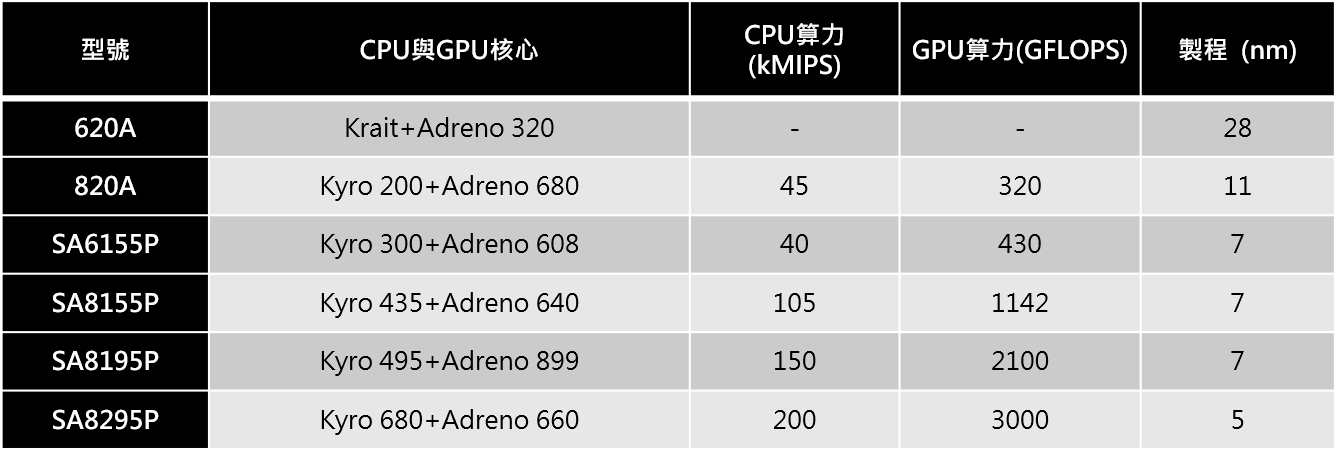
Source : Qualcomm; organized by Jipu Industrial Trend Research Institute, 2024/03
- Renesas: Renesas is not only the leading manufacturer of automotive MCUs, but also holds the second largest market share for smart cabin master SOC chips. 2018 will see the launch of the third generation of the R-Car M3 and R-Car H3, the mid-range model and the high-end model, which will use the 28nm and 16nm process, respectively. 2021 will see the launch of the enhanced version with an increased processing speed of 2GHz, which includes the R-Car H3e, R-Car M3e, and R-Car M3Ne. H3e, R-Car M3e and R-Car M3Ne.
Table 2: Renesas 3rd Generation Master SOC Chip Product Specifications

Source : Renesas; Collated by Ji-Pu Industrial Trend Research Institute, 2024/03
 March_Intelligent Cabin Chips|Global Intelligent Cabin Chips Technology Development Overview Discussion
 March_Smart Capsule Chipset Topics|Global Smart Capsule SoC Chipset Supplier Product Technology Analysis(Part2)