Intel AI晶片專題|Intel 在AI 晶片之產品與策略意圖剖析(下)
Author: Mr. Lin Weizhi, Executive Vice President, Ji-Pu Industrial Trend Research Institute
- Server GPUs have achieved initial results, but market share increase still needs time to fermentation
Intel has been developing GPUs for some time, and its product strategy is similar to that of NVIDIA, which is to develop a GPU architecture, and then develop different GPU products according to the applications of laptops, desktops, and servers, etc. Intel's GPU architecture is Xe-Core, and its main feature is the introduction of 256-bit Vector engine and 1024-bit Matrix engine, based on which other functions, such as optical tracking, will be introduced separately to further satisfy the needs of image-based applications. Based on this foundation, if there is a need for other functions, such as light and shadow tracking, the light and shadow tracking architecture will be introduced to further satisfy the image-based application scenarios. Therefore, from a broad perspective, Intel's GPU products are generally able to cope with AI and machine learning application scenarios, but with different levels of computing power, the AI computing performance they can support also varies. In other words, Intel's AI high-computing power GPUs are still focused on the server domain, much like server processors.
In terms of GPU products for servers, Intel has divided them into two categories: the GPU Max series, and the Flex series. Both of them use Xe-Core with optical tracking units, but the versions are slightly different, with the former adopting the Xe-HCP architecture and HBM2e memory, and the latter Xe-HPG and GDDR6. The GPU Max, with its superior computing power, is only available in a module version and is made on Intel's 10nm process, while the Flex series plays a supporting role in the form of a PCIe accelerator card and is made on TSMC's 6nm process. Intel's entry into the server GPU product competition has only been formalized in recent years with clearer actions. In today's market, NVIDIA has been monopolizing this market for a long time, and although AMD has spent a lot of resources to try to capture NVIDIA's market share, it will take time for the fermentation process to confirm whether AMD's product strategy will be effective or not, and the same is true for Intel. Whether Intel can capitalize on the development of processors and AI acceleration chips to boost the market share of server GPUs will also take some time.
Table 2. List of Intel Server GPU Basic Specifications

Source:Intel's official website and press data; collated by Chipotle Industrial Trend Research Institute.
- Leveraging on UCIe Alliance, deeply integrating with Taiwan's supply chain
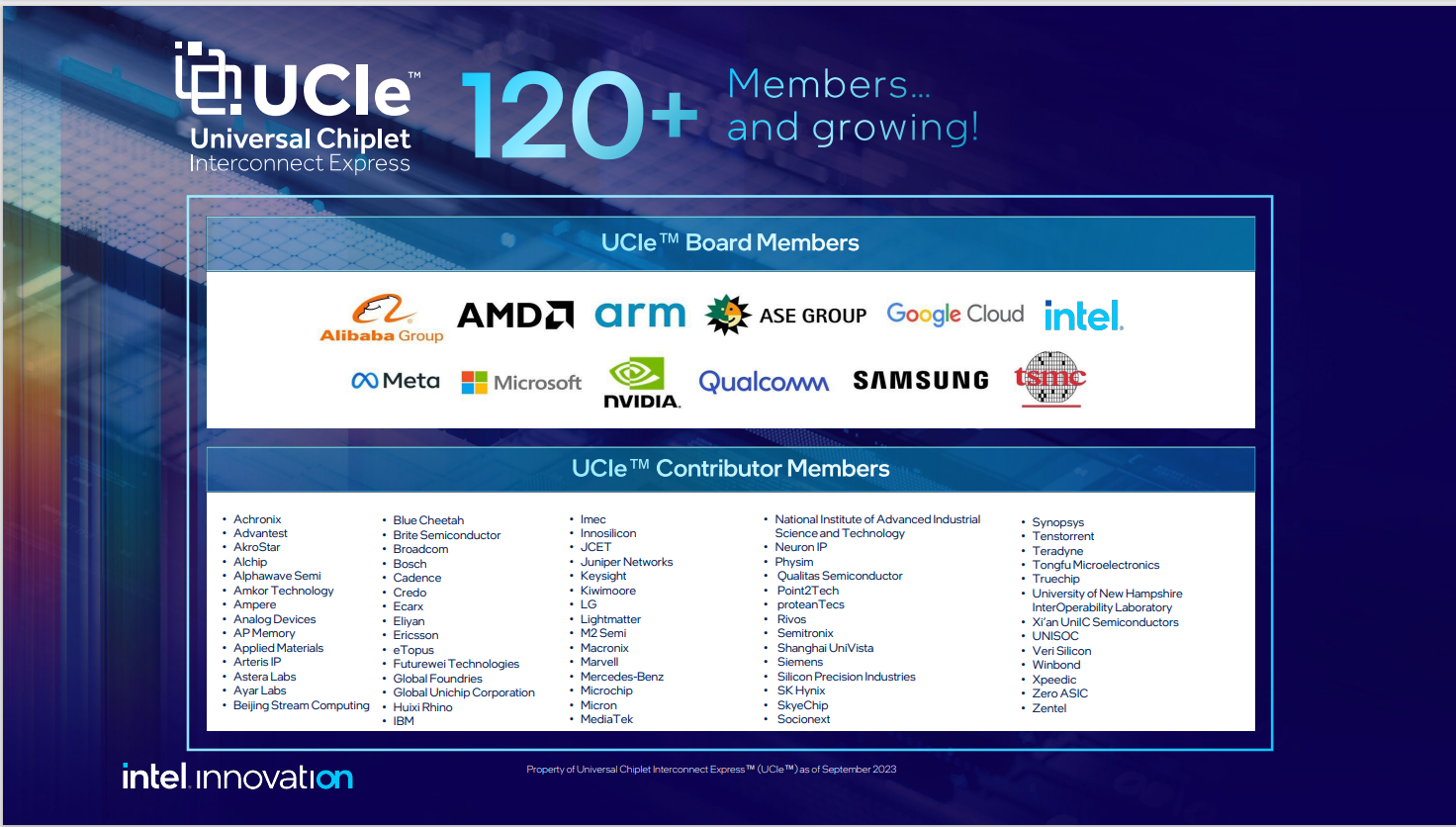
The UCIe Alliance, to be established in 2022, focuses on the fact that in the past, major semiconductor companies have developed their own technologies in the advanced packaging field, making it impossible for technologies such as advanced packaging and chiplets to develop rapidly by means of a unified standard in the industry. Therefore, Intel, TSMC, and Sun Micron, among others, have jointly established the UCIe Alliance to accelerate the development of advanced packaging and other related technologies and the industry chain. development of advanced packaging and other related technologies and industry chain.
Figure 2. Current Membership of the UCIe Alliance
Source: Intel Innovation Day 2023
Intel itself has been developing advanced packaging technologies such as EMIB and Foveros for many years, and has also invested in advanced packaging plants in Mexico and other places to cope with the huge demand for high-speed AI computing in the future. Now, the company has joined hands with TSMC and Sun Micron and other Taiwan-based supply chain companies, which are also interested in the technology and production capacity of Taiwan's supply chain, which can match with Intel's IDM 2.0 strategy, and thus expand more customer sources. From Intel's many high-computing power products, we can see that HBM is inevitable. In addition to its packaging and testing factories, how to effectively cooperate with Taiwan's supply chain to ensure stable shipments will be one of the key points in Intel's layout.
Although Intel itself is an IDM company, it has recently intended to operate its IFS department and chip design independently internally, making the IFS department similar to an independent company, so as to activate the degree of upgrading of wafer fab processes and the pace of capacity expansion, and such an approach for Intel to return to its position as a leader in advanced manufacturing processes, as well as to widen the gap in the field of computing ICs with its rivals, is not a trivial task, but has its strategic value. This is a difficult task for Intel to return to its position as an advanced process leader and to widen the gap with other competitors in the field of computing chips. Objectively speaking, the key to determining the computing power of a chip lies in the circuit design and process nodes. In recent years, with the rise of advanced packaging and HBM technology, which has boosted the computing performance of AI model training and high-computing-power chips, NVIDIA's investment has been made much earlier than that of Intel, which is one of the reasons that NVIDIA has been able to hold the limelight for a long period of time in the global AI chip field. In Intel's current situation, since the advanced manufacturing process is not as good as TSMC's, it is not enough to close the gap with NVIDIA with the instruction set and even circuit design advancement for the time being.
At TSMC's first press conference in 2024, President Chieh-Chia Wei said that the market recovery is driven by ai computing chips, and that the compound annual growth rate (CAGR) of the ai-driven HPC market in the next few years will be greater than 50%, which directly represents that the ai server industry has entered a high-growth stage, and that the demand for ai chips will be very strong. During the 1/26 conference call, Pat Gelsinger said that although the amount of external foundries will decrease in the future, they will remain an integral part of Intel's wafer fabrication development path. The use of external foundries for outsourcing will also be an important part of Intel's growth strategy. Therefore, Intel will continue to maintain its commitment to outsourcing so that its R&D teams can produce products using industry-leading technologies.
In this trend, Pat Gelsinger did not specify when or at what point the amount of outsourcing will start to decrease, but in the short term, the supply chain cooperation between Intel and TSMC will become closer. The transfer of some GPU products and AI acceleration chips to TSMC, and the joint development of 12nm wafer foundry with UMC, etc., will allow Intel to remain competitive at the poker table. At the same time, continue to strengthen the IDM 2.0 strategy, waiting for the market once again production capacity can not catch up with the demand situation, the opportunity to stabilize the production of higher cost-effective products by its own IDM characteristics, such as glass substrate PLP, etc. to increase market share, so as to have the opportunity to enhance the market share of products other than the CPU. In addition, Intel's Innovation Day held in Taiwan last year, Pat Gelsinger also showed the initial results of cooperation in the UCIe, through Chiplet and UCIe technology, Intel 3 and TSMC 3nm process die to be integrated in a single package, is expected to enter the mass production schedule in 2026 at the earliest. Therefore, deepening the cooperation with Taiwan's supply chain and continuing to develop IDM2.0 will be Intel's strategy to win the competition for AI chips. In addition, the IFS Direct Connect event, which will be held for the first time on February 21st, is expected to reveal more information about the Taiwan supply chain and the development of Intel's AI chips.