July_GAI Topic|GAI trend reshapes the server industry chain
AI applications are blooming, many people are afraid that they will be replaced by AI, AI authority Ben Goertzel (Ben Goertzel) said: Artificial intelligence may replace 80% of human jobs in the next few years, but I don't think this will constitute a threat, it's a good thing. It's a good thing. People can find more meaningful things to do than just work for a living," says Goetzel. Götzel agrees that almost all clerical work should be automated, while ITU Secretary General Doreen Bogdan-Martin warns that AI could eventually lead to a nightmare scenario in which millions of jobs would be at risk, and unchecked development of AI could lead to untold social upheaval, geopolitical instability and economic disparity. GAI (Generative AI) applications have been all over the world in recent months and have been discussed in previous articles. However, as the warnings from all sides become more and more mundane, I am not sure if it means that lives are about to be threatened or changed, and jobs are going to be replaced in large numbers, but I am sure that the AI Generation is creeping up on you and me from afar.
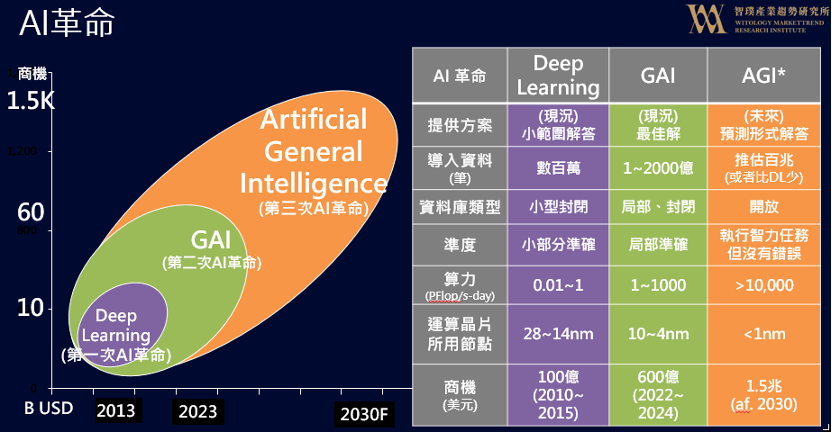
The world's first Artificial Intelligence (AI) robot press conference was held in Geneva, Switzerland, on the 7th of this month, in which nine distinctive anthropomorphic robots (humanoid robot) made a rare appearance on the same stage. The nine AI robots emphasized that their role is to work alongside and help humans, and that they have no intention of taking away human jobs or even overthrowing human rule, despite suggesting that they would be more effective as government leaders, and despite rolling their eyes at questions from attendees. The responses of these nine so-called humanoid robots using GAI technology have really turned many people's imaginations upside down. They will excite AI worshippers and creep out the anti-AI crowd. Regardless of whether they can really rely on human free will to say these responses or whether they are generated by deliberate training of fixed items, ChatGPT has been a booming development of AI since the end of last year, and we believe that it can be regarded as the second revolution of AI at the present time.
- The first revolution was when Deep Learning matured. Before that, AI was more like a science fiction to the general public, such as the movie Devil's Terminator. Deep Learning (English: Deep Learning) is a branch of Machine Learning, an algorithm that uses artificial neural networks as a framework for learning representations of data. The adjective "deep" in Deep Learning refers to the use of multiple layers in a network. Simply put, it allows computers to advance to the concept of accurate judgment and learning.
- Next is the GAI trend driven by ChatGPT, which took off at the end of last year, and which we consider to be the second revolution of AI. It applies more computing power and database training to quickly produce humanoid simulations and answers that are difficult to determine whether they are true or false in the first place. Depending on the type of database, it is highly skilled in a specific field or task, and can generate text, images, video and audio, etc., and talk to the user. In other words, any AI that needs to be prompted to generate content or respond to requests by accessing stored information can be categorized as a GAI, e.g., the common text-to-speech and image-to-image translators, as well as more recent developments such as DALL-E, the pattern-based Generative Adversarial Network, and Generative pre-trained Transformers (GPT-3, GPT-3.5, GPT-4). Currently, they specialize in one or a few specific tasks, like an honorary professor in a very niche subject. The general public's perception of AI products has shifted from "artificial" assistants that may only be able to answer certain specific questions to "human" beings that can think for themselves in specific areas.
- The third revolution, we believe, is the emergence of AGI (Artificial General Intelligence), and when it reaches this stage, it will continue like the current digital industrial revolution. When it reaches this stage, it will continue like the current digital industrial revolution, where AGI can think, reason, perceive, deduce, and do what all humans can do. This is the meaning of General Artificial Intelligence. Theoretically, AGI (General Artificial Intelligence) can perform any intellectual task just like humans, but with fewer or no errors. Google's DeepMIND and MeTa's chief AI scientist Li-Kun Yang's launch of the new I-JEPA architecture in mid-June are closer to the concept of AGI. In the future, AGI is likely to play an important role in every conceivable field. For example, AGI combined with biotechnology can provide quality healthcare at a fraction of the cost. It can personalize treatment plans and speed up diagnosis with minimal errors; it can achieve fully automated driving, just like a driver who will never drink and drive and has no emotions to help the user; it can be an ace lawyer, writing perfect pleadings and discovering many subtle flaws; it can also be used to do more and more in a variety of fields, such as automation, research, education, agriculture, space exploration, and even more than many others. And even more than many others.
圖一. AI革命與對應的商機規模
Source:MarketsandMarkets; Bloomberg;
*目前尚未有明確技術,相關內容為推測;智璞產業趨勢研究所整理 2023/07
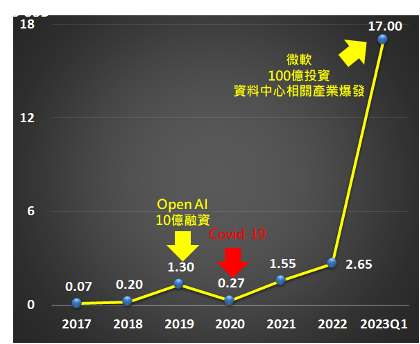
這波GAI速度之快真讓我們措手不及,商機成長的潛力好比.COM、PC或Mobile Communication。從AI融資來看,2022 年約 26.5 億美元,2023Q1 就高達 170 億美元[一座12吋 5nm 月產能5萬片的晶圓廠,需150~170 億美元],其中光 Open AI 就獲得微軟 100 億投資,如下圖二。
圖二. 全球AI相關融資
Source:CBINSIGHTS;智璞產業趨勢研究所整理 2023/07
在巨頭們屢屢把資金投入的推波助瀾下,AI 大戰已正式開打。根據 Grand View Research 研究,AI 產業產值(軟體+硬體)將在 2030 年超過 1.5 兆美金,未來 7 年以 37%年複合成長率快速向上爬升。以過往經驗,當大家都投入資源進入一個產業或領域時市場可能還是一片藍海,商機必然可期,產業背後有許多投資機會,但商機在哪、投資機會在哪裡?從產業分析的角度來看,目前GAI 要持續成長的的四大議題分別是:
- 演算法:是AI 邏輯及模型的核心,決定各家AI產品優劣的關鍵,同時會有大量的人才需求。
- 數據與資料:產出的正確性與質量取決於資料的數量,換言之代表著AI進步的速度。擁有高品質的大數據系統將成為決定AI給出答案精準度的關鍵。
- 可信賴度:分為數據的可信度與製造鏈的信賴度,數據需確保AI能被安全合理的發展,確認輸出資訊的準確性、AI使用的安全性與合理性等;製造鏈的信賴度,指的是在國際地緣政治的的對立下,如何建立有效且穩定的供應商與客戶之信賴度關係。
- 算力:為所有 AI 運算、訓練及發展的基礎建設。
這四個議題,其實都充滿了商機,且會有不同的競爭方式出現。而台灣可以在這一波浪潮下「立即」受惠,就是因為對算力的需求,而帶動硬體的成長,如 晶片/半導體/ 伺服器。
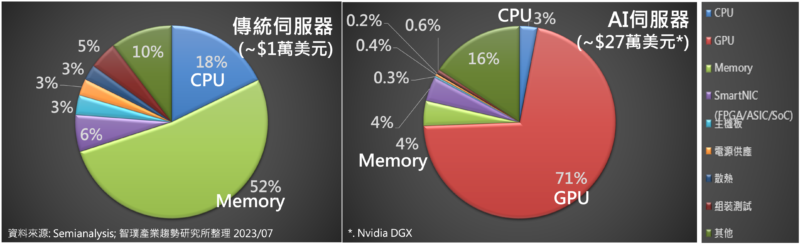
在這一波,有個熟悉又陌生的名詞出現,稱為AI Server(AI 專用伺服器)。有別於傳統伺服器用CPU來運算,需要大量的記憶體做存儲;AI Server使用CPU+GPU的架構,把大部分的運算丟給GPU做,運算貢獻占整體運算的80~90%;CPU,只占整體10~20%。同時需要搭配高速傳輸的晶片、存取、系統不然快速的運算變成枉然。由於市場對算力的高度需求,AI Server 的需求有爆發性的成長。2022年AI Server 出貨量粗估達60萬台(包含1顆CPU+1顆GPU含以上機種),其中NVIDIA 的 DGX約有7~9萬台(1顆CPU+8顆GPU);2023年AI Server 出貨量有機會破百萬台。除了因為基期低帶來的翻倍成長外,產品單價也是一個亮點。傳統伺服器一台要價1.2~1.5萬美元,AI Server 因為成本上升,售價也翻倍成長,以NIVDIA H100 DGX 要價接近27萬美元。其成本結構,如下圖三。晶片的部分大約占成本的70~80%,GPU占其中的71%,其次是CPU/Memory與Smart NIC 的FPGA/CPLD/ASIC與小IC;剩餘20~30%為網路交換器、電源供應、基板、散熱、被動元件、光纖等,這些部分雖然成本佔比低,但在整體價格上揚的情況,為供應商所帶來的營收貢獻仍然可期。
圖三. 伺服器成本架構比較
Source:Semianalysis;智璞產業趨勢研究所整理 2023/07
若以NVIDIA 的AI Server 為例,晶片/IP的供應商、製造商如圖四,其中黃色為台灣上市櫃公司。裡面的的CPU/GPU晶片商,主要以Intel/AMD/NVIDIA 為主,這三家的競合關係也在前幾篇有所討論。在記憶體的部分,由於高速運算所需,因此記憶體的速度也非常要求,傳統用DDR,導入HBM((High Bandwidth Memory)的需求也就一併上升。這是一基於 3D 堆疊工藝的高效能DRAM。光HBM 的市場在2026達51億美金,CAGR>30%。在裡面主要的製造商以三大記憶體製造商為主,SK 海力士(53%)、三星(38%)、美光(9%)。相關的受惠台灣廠商是台積電,因為其CoWoS封裝技術協助GPU廠商可直接將記憶體堆疊在GPU旁邊;另外還有台灣的創意、世芯擁其在封裝時必要的周圍控制器與實體層控管資料傳輸IP,預計同樣受惠。
圖四. NVIDIA DGX晶片/IP供應商
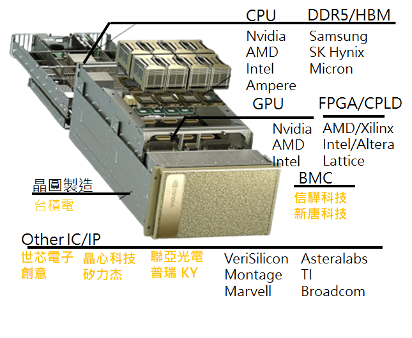
Source: NVIDIA; Collated by Ji-Pu Industrial Trend Research Institute 2023/07
另外,也有許多小IC 值得關注,像是遠端伺服器管理晶片(BMC)。BMC是伺服器裡面拿來跟內外部溝通的主要IC,所以算是伺服器裡面必須要有的key part,且由於AI 伺服器的資安、散熱控制等有別於傳統伺服器,一台大約需要5顆做有的IC,台灣的MCU 廠商 信驊、新唐等都有受惠。
這一波GAI的浪潮下,當紅炸子雞應以NVIDIA 莫屬。在前面的文章也有剖析過為何在GPU的市場上會有超過85%的市佔率。然而,在這一波洪流下,其實台灣伺服器產業鏈也迎來了一個重要時刻。有別於傳統伺服器產業鏈由品牌商(DELL/HPE/Lenovo…)統包,開出晶片、元件等需求給代工廠生產,最後出貨終端客戶;而AI伺服器改變成短鏈模式,由晶片大廠(NVIDIA/AMD/Intel) 偕同台灣ODM+CPS的終端客戶共同開發。如此終端客戶可以拿到更好效能、更便宜價格的產品。ODM能展現台灣整合設計與產業聚落優勢。同樣再以NVIDIA 不同AI晶片/模組/系統之產品類型為例,如圖五。目前很紅的DGX伺服器在2022年的營收貢獻上,仍屬微小,其數據中心的營收主要的貢獻還是來自於GPU模組與GPU基板,然而不論之後比重會如何變化,其生產供應商皆以台灣廠商為主。因此在這一波浪潮下將重塑全球伺服器產業鏈。
Figure 5. ODM of NVIDIA AI-related products
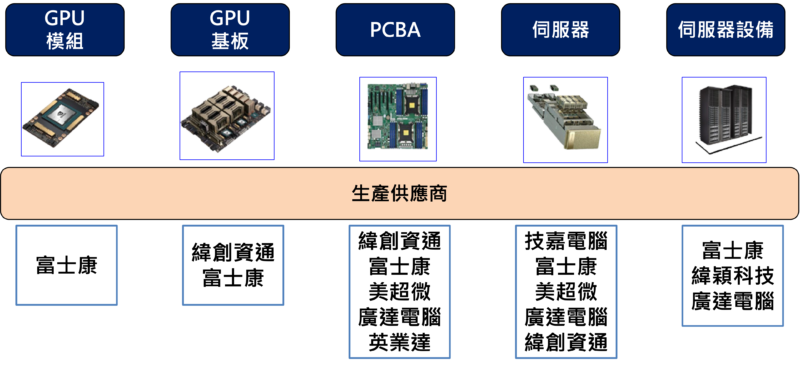
Source: NVIDIA; Collated by Ji-Pu Industrial Trend Research Institute 2023/07
 July_GAI Topic|Analyzing the market competition among Intel, AMD and NVIDIA from the perspective of computing architecture development (Next)
 August_Semiconductor|Advanced Packaging Technology for High Performance Computing Chips(Up)