Industry Trend Report|Global Type III Semiconductor Major Manufacturers Development Status
carbonizesilicon (chemistry)industryChain
The silicon carbide industry can be divided into upstream substrate/epitaxial, midstream components/modules, and downstream systems, etc. Silicon carbide has a variety of isotropic structures, which can be divided into two main categories, the first is diamond-like sphalerite crystal structure of 3C-SiC (β-SiC), and the other is the hexagonal crystal structure of fibrous zinc ore, typically 6H-SiC, 4H-SiC, 15R-SiC (α-SiC). Typically, 6H-SiC, 4H-SiC, 15R-SiC (α-SiC), 4H-SiC and 6H-SiC are the most commonly used in the semiconductor field. In terms of wafers (substrates), silicon carbide wafers are in a state of oversupply, with foreign suppliers such as II-VI, Wolfspeed, Norstel, STMicroelectronics, Dow DuPont, and others. One of the major reasons for the high cost of silicon carbide components is the difficulty of wafer manufacturing, which accounts for about 50% of the cost of components, followed by 25% of epitaxial, 20% of component manufacturing, and 5% of packaging.Currently, the production of silicon carbide wafers is mainly in the range of 4-6 inches, and 4-inch wafers have been gradually replaced by 6-inch wafers since 2017, and the current production volume is the first one. Although some fabs have begun to produce 8-inch wafers, crystal defects still cause a decline in the yield of the subsequent component manufacturing process, so no component fabs have yet to enter mass production. Market research firm Fuji General Research estimates that 4-inch and 6-inch wafers will be produced in 2025 at 20,500m2 and 20,500m2 respectively.2780m2Foreign suppliers include II-VI, Wolfspeed, SiCrystal, Rohm, Norstel, Showa Denko, Transform, Dow DuPont, Nippon Seitetsu, Novasic, Denso, Aymont, and Siltronic. The quality and surface characteristics of silicon carbide substrates do not meet the requirements of device manufacturing, so an additional layer of high-quality epitaxial material must be deposited on the surface of the substrate before manufacturing various devices. Due to the problem of sublimation, the epitaxial temperature cannot exceed 1,800℃, thus the growth rate is slow. Currently, foreign epitaxial manufacturers include II-VI, Wolfspeed, SiCrystal, GTAT, Rohm, Ascatron, Denso, GE, Bosch, Mitsubishi Electric, Toshiba, Panasonic, ST Microelectronics, Infineon, On Semiconductor, Microsemi, Norstel, Showa Denko and others. Since wafer supply is a key factor in the development of the silicon carbide industry, major component companies are targeting upstream material manufacturers for mergers and acquisitions or booking production capacity in advance. For example, Infineon will sign a five-year wafer supply contract with GTAT in 2020, and ST Microelectronics has expanded its long-term wafer supply agreement with Wolfspeed, which will continue to supply 6-inch wafers and epitaxial wafers for a few years. The latter will continue to supply 6-inch wafers and epitaxial chips for several years, totaling over US$800 million. Foreign IDM suppliers include Littelfuse, Infineon, ST Microelectronics, II-VI, Wolfspeed, SiCrystal, Rohm, GE, Bosch, Mitsubishi Electric, Toshiba, Panasonic, Fuji Electric, GeneSiC. IC designers include Bruckewell, Littelfuse, and Monolith Semiconductor. The major vendors in the industry chain are shown in Figure 1.
圖一、碳化矽產業鏈的重要廠商名單
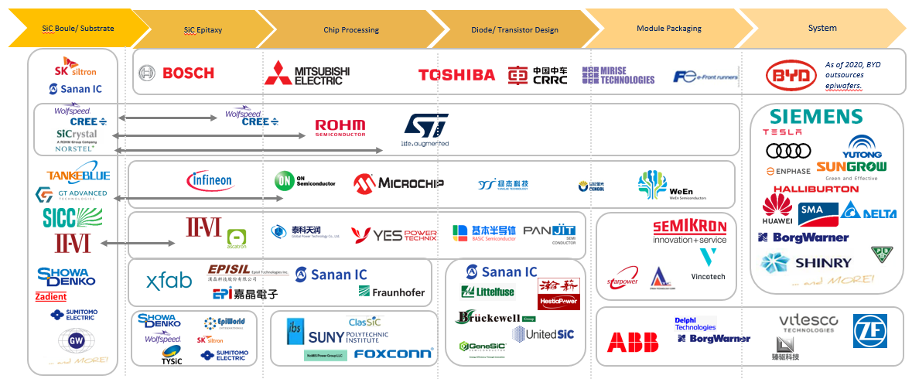
資料來源:Yole Développement
氮化鎵產業鏈
氮化鎵產業亦可分為上游基板/磊晶、中游元件/模組、下游系統等領域,呈現垂直分工和垂直整合並存的狀況。以市場主流的GaN on SiC產業來看,基板如前段所敘,氮化鎵磊晶難易度取決於基礎襯底材料,不同基材晶格與磊晶材料間相容性是決定缺陷密度、成長面積、製程良率的關鍵,雖然氮化鎵與碳化矽的晶格匹配性佳可成長優質單晶層,但因碳化矽晶圓售價昂貴而使單價偏高,市場研究機構富士總研指出其磊晶片以4及6吋為主,每片價格約在1000~2000美元間,預估2025年產量為104萬片,2018至2025年複合成長率約40.2%,國外供應商有Wolfspeed、Mitsubishi Chemical、Dow DuPont、Air Water、EpiGaN、IQE、Infineon、SweGaN、Sumitomo Electric、Qorvo、Custom Mmic、Toshiba、Mitsubishi Electric、Solitec、HRL、Leonardo、BAE System、Elta Systems、Northrop Grumman、AirBus、Thales等公司。
目前GaN on SiC的氮化鎵元件主要用於國防及5G通訊等射頻應用,GaN on Si技術雖然製造成本較低,但因矽基板散熱能力較差,往高頻發展有技術上的困難,目前無法應用於毫米波頻段。這市場是以質而非量取勝,因此元件生產仍以IDM廠為主,包括Qorvo、Infineon、Wolfspeed、Sumitomo Electric、Custom Mmic、Toshiba、Mitsubishi Electric、HRL、Macom、Transphorm、Exagan、Wavice、Ums、Leonardo、BAE System、Elta Systems、Northrop Grumman、AirBus、Thales等公司,IC設計商則有Rfhic、Ampleon、Wavepia、ADI、NXP、Iconic RF等公司,其中Rfhic與Ampleon分別由Qorvo、UMS代工生產,其他國外代工商還有Wolfspeed、X-FAB、TowerJazz、BRIDG、Fujitsu、Ankor、AT&S等公司。重要廠商之供應關係如圖一所示。其中,Cree主要由其子公司Wolfspeed經營 RF 業務。2018 年,Cree收購了英飛淩的RF部門, 成為了全球最大的GaN射頻供應商。Cree除為自家生產GaN射頻外,還向外提供GaN代工生產服務。
圖二、氮化鎵射頻元件產業鏈重要廠商之供應關係
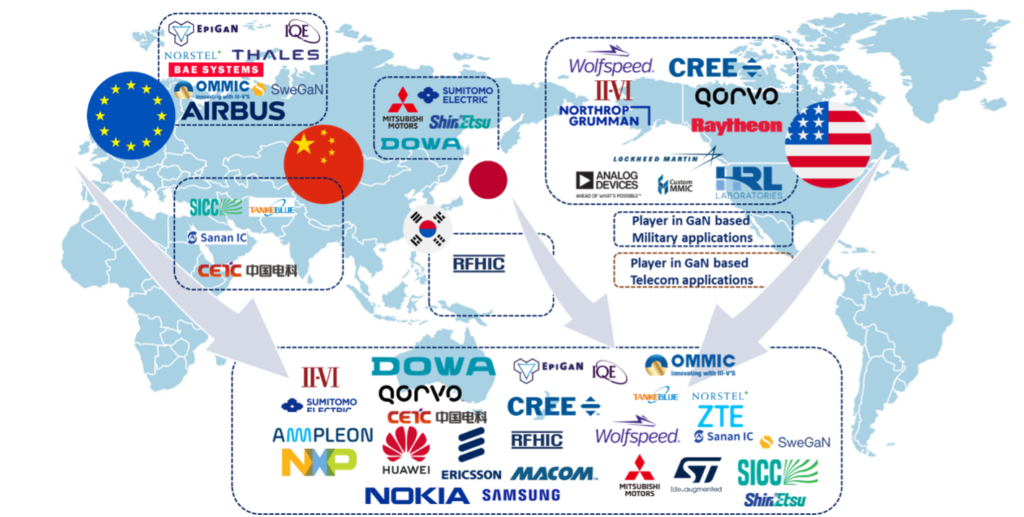
資料來源:Yole Développement;智璞產業研究院整理,2022/07
在GaN on Si產業部分,其基板使用的矽晶圓已是成熟產業,生產成本較低,目前由Shin-Etsu、Sumco、環球晶圓、Siltronic等大廠主導全球市場。氮化鎵與矽的晶格匹配性差,故不易生成高品質的磊晶層,但是矽晶圓價格便宜,且大面積化的發展進程較快,使得GaN on Si磊晶片的市售價也相對較低,市場研究機構富士總研指出其磊晶片以6及8吋為主,每片價格約在500~700美元間,預估2025年產量為為60萬片,2018至2025年複合成長率約72.6%,國外供應商有Dow DuPont、Air Water、Soitec、Coorstek、IQE、EpiGaN、Dowa、Newport、Ommic、SilTerra等公司。
2010年起氮化鎵功率元件開始商業化,最早是EPC與International Rectifier推出氮化鎵功率元件產品,基於成本考量,目前氮化鎵功率元件均以GaN on Si為主,主要由IDM廠商製造,如ST Microelectronics、Infineon、Macom、Ommic、Texas Instruments、NXP、On Semiconductor、Panasonic、Sanken、Innoscience、GaN Systems等公司,IC設計商有Transphorm、EPC、Navitas、Power Integrations、Dialog、VisIC、Qromis等公司。重要廠商之供應關係如圖二所示。
圖三、氮化鎵功率元件產業鏈重要廠商之供應關係
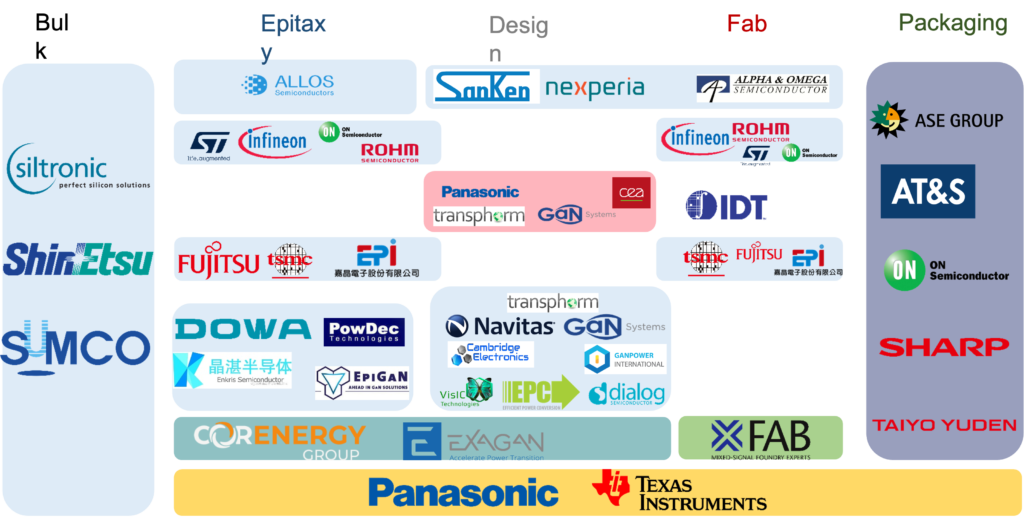
資料來源:PntPower;智璞產業研究院整理,2022/07
目前全球化合物半導體產業由歐美日企業主導,根據市場研究機構Yole Développement資料顯示,Wolfspeed、Rohm、Infineon、ST Microelectronics和Mitsubishi Electric等五家企業在碳化矽功率元件的市占率達80%,Navitas、Power Integrations、Innoscience、Transphorm等四家企業在氮化鎵功率元件的市占率達90%,Sumitomo Electric、Wolfspeed、Qorvo等三家企業在氮化鎵射頻元件市場的市占率達85%。主要大廠均大力完善產業佈局以增強競爭優勢,往產業上下游延伸態勢日益明顯。如Wolfspeed 收購Infineon射頻業務,強化GaN on SiC射頻技術領域領導地位,並出售LED照明業務,專注第三類半導體發展;Rohm收購收購SiCrystal以擴大碳化矽晶圓產能;II-VI收購Ascatron和Innovion Corporation,進行碳化矽產業鏈垂直整合,同時也計畫建立射頻GaN on SiC的技術平台;ST Microelectronics收購Norstel以確保碳化矽晶圓來源;Infineon收購晶圓冷切割技術公司Siltectra。此外,部分國際大廠正大規模擴產,未來幾年產能將逐步開出,如Wolfspeed 預計在2024 年前可將產能擴充30倍、Rohm在2024年前要將產能擴充16倍、II-VI 計畫將產能擴充5~10倍,此外,各大廠更準備將產線升級,改以更大尺寸進行量產以降低成本,擴大市場占有率。
-For more information, please clickContact Us -
 Industry Trend Report|Impacting the Future of the Technology Industry Compound Semiconductors Play an Indispensable Role
 Industry Trend Report|Class III Semiconductors Reinventing Critical Technologies for Electric Vehicles, Defense, and Aerospace