July_Precision Medicine|Saliva RNA for Concussion Diagnosis: A New Highlight in the Concussion Screening Market
Traumatic brain injury (TBI) is an injury to the brain (cerebrum) caused by an impact on the brain. Depending on the degree of severity, it is classified as mild, moderate, or severe. Mild TBI is commonly referred to as a concussion, which according to JSPRM and Global Information affects more than 69 million people worldwide each year. Although concussion accidents are very common, it is estimated that as many as 80% concussions remain undiagnosed. Neglecting concussions may lead to headaches, nausea, depression, and inability to concentrate, as well as repeated concussions, which may aggravate the intensity of the symptoms and lead to memory loss, dementia, and serious injury. In severe cases, it may lead to memory loss, dementia and Parkinson's disease.
Traumatic brain injury is best diagnosed at the time of injury or within the first 24 hours. Current clinical diagnostic protocols are based on symptomatic and neurological imaging, including case reports of symptoms, clinical scales of cognitive testing, and functional brain imaging, such as CT or MRI, with CT computed tomography (CT) being the standard for the clinical diagnosis of concussion. Although functional brain imaging is helpful in diagnosing the location and extent of injury (cerebral hemorrhage), concussion is often difficult to detect because people who have suffered a concussion may not have any obvious brain injury, and many patients with brain injuries report perfectly normal EEG/CT/MRI examinations. Because specific biomarkers appear in cerebrospinal fluid, blood, or saliva at the early stage of brain injury, changes in these biomarkers can be measured to determine the presence or severity of brain injury, and can even reflect the changes in the human brain a few hours or even a few days after the trauma, and these specific biomarkers, such as GFAP (Glial Fibrillary Acidic Protein), UCH-L1 (Ubiquitin Carboxylic Acid Protector), UCH-L1 ( Ubiquitin Carboxy-Terminal Hydrolase Isoenzyme L1), serum S100B protein, or RNA, can help in the early screening of patients with concussion who do not yet have obvious symptoms for early detailed brain function imaging or follow-up treatment, and can help to rule out follow-up computed tomography (CT) in patients with minor brain impacts that do not result in concussions (with negative results). For patients with minor brain injuries and no concussion (negative test results), this can help to eliminate the need for follow-up CT scans and reduce the length of time the case spends in the hospital.
全球創傷性腦損傷診斷市場醫學影像仍是主流,創新技術緊追在後
根據Growth Plus Reports報告,2022年全球創傷性腦損傷診斷市場規模約74.2 億美元,腦功能醫學影像診斷仍是市場主流,預估到2031 年可成長 1.4 倍,達到 105.1 億美元,複合年增長率為 3.95%,創傷性腦損傷在美國每年造成30萬人腦震盪送醫院和220萬人次急診就診,其中2/3為兒童和青少年人群,在歐洲每年則約有300萬人因疑似輕微腦震盪前往醫院檢查,台灣每年則有近2萬人為腦震盪後症候群,據估計全球每年創傷性腦損傷所造成的醫療負擔就高達4,000億美元,近年來受惠於與創新診斷工具如VR/AI影像診斷技術和新生物標誌物,如表一,為腦震盪早期精準診斷開啟新藍海市場。
表一、微生物組新藥研發代表公司
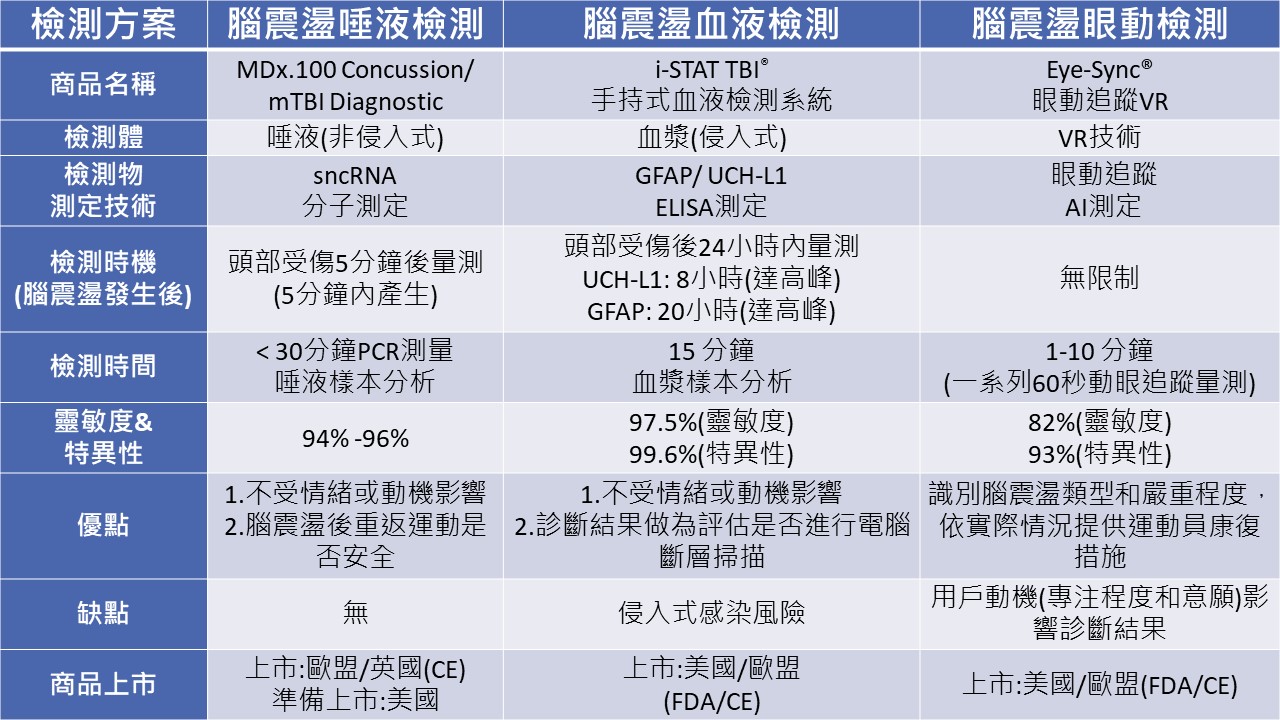
Source of information:Organized by Ji-Pu Industrial Trend Research Institute
腦震盪早期診斷方案新突破,唾液RNA和血液特定蛋白檢測後勢可期
綜觀腦震盪早期篩檢技術的發展與熱門運動賽事如美國美式足球、英超橄欖球,以及軍事領域的潛在腦損傷診斷市場息息相關,創新腦震盪檢測技術涵蓋從全血、血清、血漿、外泌體、腦脊液、唾液,以及眼動追蹤、腦(電)波測量和醫學影像等檢查,從中挖掘具有臨床診斷價值的生物標誌物,目前已知症狀和神經認知測試的腦震盪診斷準確率僅約88.8%,而現行創新檢測技術對腦震盪診斷準確率可達93%以上,將彌補臨床上腦震盪排篩不易和準確性不佳的需求缺口,此外,腦震盪評估設備的技術進步將為該市場創造新商機,包括腦震盪早期更精準檢測、腦震盪快篩時效,或腦震盪後續恢復監測或訓練,其中創新技術如唾液生物標誌物和血液生物標誌物的發展優勢在於眼動追蹤腦震盪測試有可能受到個案的情緒和動機干擾而導致檢測失效,而生理生化的變化如唾液RNA和血液特定蛋白則不受外界干擾因素影響,並有助於了解腦震盪病理成因,促進腦震盪後續監測診斷和治療藥物的技術發展。
從體外診斷試劑來看,更快、更便宜、更準且多項項目同步檢測是市場產品開發的趨勢,其中操作便利性如手持式設備,或採檢簡便如唾液採樣(非侵入性)只需幾秒鐘,或抽血採樣(侵入式)可能對於現場或兒童存在一定限制和風險,以及檢測速度和臨床效益也是重要開發關鍵因素。
-For more information, please contact us at
 June_New Drugs|Microbiome therapy is back in the spotlight with FDA approval of new oral bacterial drug
 September_New Drugs|Nucleic Acids: A New Blue Ocean: New Drug Development Opportunities in the Spotlight