
April_ChatGPT Discussion|Global AI Development Process and Trends
At a time when ChatGPT is exploding in popularity, the term Artificial Intelligence has returned to the center of market discussion. Artificial Intelligence (Artificial Intelligence) refers to the use of a variety of information technology to create a machine with a variety of human capabilities such as perception, cognition, creation, intelligence, and so on, and is also known as machine intelligence, is a can observe the surrounding environment and take action to achieve the goal of the intelligent subject (Intelligent). Agent.) The concept first appeared in 1955 by John McCarthy, Marvin Minsky, Nathaniel Rochester, Claude Shannon and other scientists co-authored the Dartmouth Summer Research Project On Artificial Intelligence (A Proposal For The). A Proposal For The Dartmouth Summer Research Project On Artificial Intelligence" written by Nathaniel Rochester, Claude Shannon, and other scientists, because the first conference on artificial intelligence was held at Dartmouth College in the United States in the following year, 1956 is now generally recognized as the first year of artificial intelligence. Mr. Kai-Fu Lee, an AI expert who has served as the global vice president of Apple, Microsoft, and Google, puts forward five definitions, including: (1). Artificial Intelligence is a computer program that people find unimaginable, (2). Artificial intelligence is a computer program that is similar to the way human beings think, (3). Artificial intelligence is a computer program that resembles human behavior, (4). Artificial intelligence is a computer program that learns, (5). Artificial Intelligence is a computer program that acts rationally based on its perception of the environment to maximize its effectiveness. Artificial Intelligence can be roughly categorized into five development phases as follows.
- The period between 1950 and 1974 was a period of initial development. Since it was before the emergence of the Internet, it is called Classical Artificial Intelligence. The "Symbolism" and "Connectionism" developed at this time were the prototypes of the "Expert System" and "Deep Learning" in the future, respectively.
- The period between 1974 and 1980 was a period of reflection and development. The breakthroughs of the previous period greatly raised scientists' expectations of AI, and they began to attempt more challenging tasks and propose unrealistic goals for research and development. However, a series of failures and unfulfilled expectations led to a downturn in the development of AI. Two academic reports were published that led to a drastic reduction in research funding, including the 1966 American Automatic Language Processing Advisory Committee's "Language and Machines: Computers in Translation and Linguistics", and the 1966 "The Role of Computers in Translation and Linguistics", a report on the development of artificial intelligence. Language and Machines: Computers in Translation and Linguistics" by the Automatic Language Processing Advisory Committee and "Artificial Intelligence: A General Survey Report" by Prof. Sir James Lighthill of the United Kingdom in 1973, both of which expressed disappointment at the failure of previous investments to yield the expected benefits. Both expressed disappointment that their previous investments had failed to produce the expected benefits and suggested that they should not continue to invest in the bottomless pit of artificial intelligence.
- The period of application development between 1980 and 1987. The popularity of computers made the research in this period mainly utilized expert systems that instilled expert knowledge as rules to help solve specific problems, and usually prepared a large number of responses to a predefined problem in advance. However, it does not have the ability to learn on its own, so the application is limited and the boom is gradually fading.
- Between 1987 and 1993, there was a downturn in the development of expert systems. As the scale of AI applications continued to expand, the problems of narrow application areas, lack of general knowledge, difficulty in knowledge acquisition, single reasoning method, lack of decentralized functionality, and difficulty in compatibility with existing databases were gradually exposed in the expert system. Coupled with the increasing power of personal computers (PCs), the governmental agencies felt that investment in AI did not have a significant effect, which led to a drastic reduction in the amount of funding for research.
- Since 1993, the development of machine learning technology has been booming. With the popularity of high-performance computers, the Internet, big data, sensors, and declining computing costs, machine learning technology has emerged, which allows computers to learn a large amount of data to recognize sounds and images like humans, or to make appropriate judgments on problems. In addition, breakthroughs were made in computer vision and natural language processing. During this period, corporations gradually replaced the government as the main source of research funding for AI technology.
目前人工智慧技術主要依據1980年美國University of California-Berkeley的哲學系教授John R. Searle提出的方法分成弱人工智慧與強人工智慧等兩類。前者只能模擬人類的思維與行為表現,但缺乏真正的推理與解決問題的能力,也不具有自主意識與思考能力。它只專注於解決特定問題,例如:圖像辨識、語言翻譯、玩圍棋遊戲等,所以仍然屬於「工具」的範疇;後者是具有與人相同程度的智慧,除了可以自我學習並處理未遭遇過的問題外,還有人格與自我意識,可以像人一樣獨立思考與決策,並與人類相互交流學習。當前全球各國都認知開發人工智慧的重要性,一些科研大國已提出相關政策以積極推動技術與應用發展,相關整理如下:
- 美國:為了持續保有世界領導地位,美國積極發展人工智慧技術。2016年白宮科技政策辦公室(OSTP)發布《為人工智慧的未來做好準備》、《國家人工智慧研究和發展戰略計劃》和《人工智慧、自動化與經濟報告》等報告以全面建立人工智慧戰略實施框架,並設立專職負責機構推動人工智慧技術,先後成立美國國家科技委員會(NSTC)、機器學習與人工智慧分委會(MLAI)及網絡與資訊技術研究發展分委會(NITRD),由政府引領方向以協助美國產業與科技發展。
- 歐盟: 歐盟委員會在2018年發表的「歐洲的數位未來」之政策提到人工智慧的發展策略,認為人工智慧可以提高歐盟的研究與生產能力,並促進民眾生活便利與經濟發展,但它產生的道德、法律、社會倫理等方面問題需要積極解決。
- 英國: 2016年科學與技術委員會發布《機器人和人工智慧》報告,提出機器人與人工智慧將帶來生產力與效率,將改變人們生活,但相對的亦會引發相關道德與法律問題,應建立相應機制與準則;同年科學辦公室發布《人工智慧:機會與未來決策影響》報告,針對人工智慧及應用界定與發展、未來對社會及政府利益及衝擊及相關道德、法律風險議題提出建議,呼籲政府應建立透明、可歸責的監管機制,並利用人工智慧領域的既有優勢增強國力。2017年英國政府發布《在英國發展人工智慧》報告,指出人工智慧將為英國提供8,140億美元的經濟增長,總產值(GVA)年增長率從5%提升至3.9%,其設定目標是使得英國成為世界上最適合發展和部署人工智慧的國家。
- 中國: 2017年國務院發布「新一代人工智能發展規劃通知」,內容包含研發、工業化、人才發展、教育和職業培訓、標準制定和法規、道德規範及安全等各個方面的戰略和發展目標,並提出三大戰略與目標,前者包括:(1).2020年人工智慧產業與最強競爭者齊頭並進,(2).2025年在一些人工智慧領域實現世界領先水準,(3).2030年成為全球人工智慧創新的主要中心;後者包含:(1).2030年人工智慧產值達到1兆人民幣,而相關產業的總產值達到10兆人民幣,(2).招攬全球最優秀的人才,加強對國內人工智慧勞動力的培訓以配合時代的需求,(3).促進人工智慧的發展,並在法律、法規和道德規範方面引領世界。
- 日本: 2014年日本政府修訂「日本振興戰略」,提出機器人驅動的新工業革命,2015年提出「日本機器人戰略:願景、戰略、行動計劃」,明確指出研究和發展有人工智慧的次世代機器人是趨勢所在。2016年頒布《第5期科學技術基本計劃》,提出建立「超智能社會0」,並將人工智慧作為實現超智能社會的核心。同年7月發布《日本下一代人工智慧促進戰略》,在技術研發方面確立由總務省、文部科學省和經濟產業省的合作體制,並召開「人工智慧技術戰略會議」訂定人工智慧發展路線圖,以期通過運用人工智慧以大幅提高生產、流通、醫療與護理等領域效率。2019年公佈「以人為本的AI社會原則」,將人工智慧視為未來的關鍵科技,研發應用須以聯合國的永續發展目標(SDGs)為基礎,即在以人為本的思惟下,建立串聯人工智慧、機器人、物聯網等科技的超智能社會,即為尊重人類尊嚴、不同背景的大眾皆能追求幸福及永續性的社會;同年6月提出「AI戰略2019」,其政策方向包含人工智慧系統規格的統整、大數據傳輸基礎建設的完備及研發體制的強化。
- 台灣:2017年科技部提出「我國AI的科研戰略」,以建構AI主機、設立AI創新研究中心、打造智慧機器人創新基地、半導體射月計畫與科技大擂台為推動策略。2018年行政院推出「台灣AI行動計畫」,全力推動AI發展並促使產業AI化,提出AI人才衝刺、AI領航推動、建構國際AI創新樞紐、法規與場域開放與產業AI化等五項推動主軸,以期台灣成為尖端智慧國家。
近幾年人工智慧技術出現突飛猛進之發展,並迅速融入經濟、社會、生活等各種層面,根據市場研究機構IDC發布的報告指出,預估2022年全球人工智慧市場規模為4,330億美元,年增19.6%,並將在2023年突破5,000億美元的大關,還預測全球企業在人工智慧投資將從2020年的501億美元增加到2024的1,100億美元,年平均複合成長率達20.1%。市場諮詢公司McKinsey & Company認為人工智慧將帶來的變革將比工業革命規模大300倍並產生3,000倍衝擊。顧問公司Accenture認為至2035年人工智慧將可創造產值之前三大產業依序是製造、批發零售業與專業服務業,產值分別是3.78、2.23、1.87兆美元,如圖1所示。
圖1、於2035年人工人工智慧在各產業可創造的產值
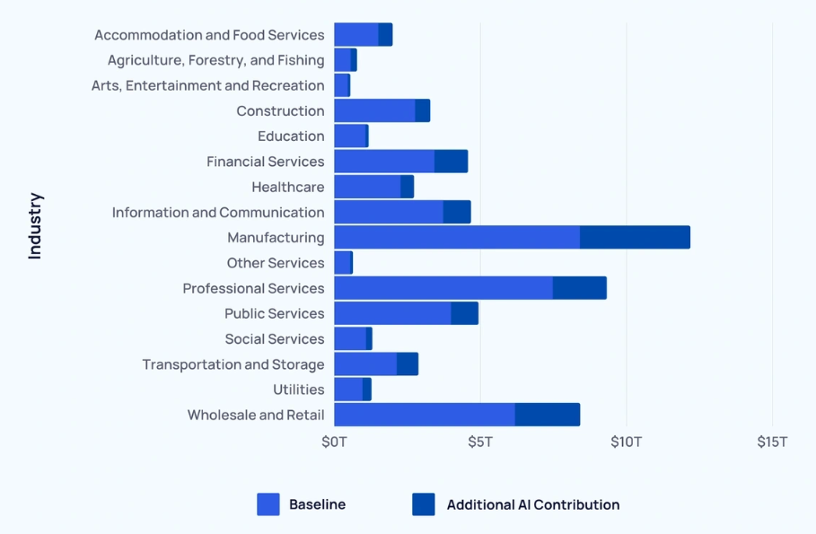
資料來源 : Accenture
資料分析機構Tortoise Intelligence每年公布全球人工智慧指數(Global AI Index),係根據七大指標對54個國家或地區進行評比,2022年全球前五名的國家依序為美國、中國、英國、加拿大、以色列,各指標的前三名國家如表1所述。
表1、全球人工智慧指數的指標意義與排行前三名國家

資料來源 : Tortoise Intelligence
 April_ChatGPT|Integrating ChatGPT, the business opportunity created by the company is explored.
 April_ChatGPT|ChatGPT Technology Development and Advantage Analysis