Industry Trend Report|Global Semiconductor 2022 Review and 2023 Outlook (Next)
2023Global Semiconductor Market and Industry Outlook
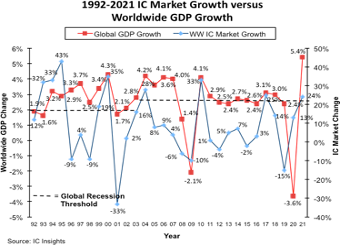
According to the long-term tracking data of IC Insights, a market research organization, the development of global semiconductor market before 2010 is mainly led by producers, and the driving force is the capital expenditure, production capacity and wafer prices. The organization analyzed that the correlation between the global semiconductor market and the growth rate of GDP was -0.1 from 1990 to 1999, and then increased to 0.63 from 2000 to 2009, and it is estimated that the correlation will reach 0.9 from 2020 to 2024, which is close to the full positive correlation coefficient of 1.0. The organization analyzed the correlation between the global semiconductor market and GDP growth rate between 1990 and 1999 as -0.1, which grew to 0.63 between 2000 and 2009, and then increased to 0.85 between 2010 and 2019, and estimated the correlation to reach 0.9 between 2020 and 2024, approaching the full positive correlation coefficient of 1.0, indicating that the global economy will be led by the global economic growth after 2010, and the driving factors will be the interest rates, prices, and fiscal stimulus measures and other important factors that affect the GDP. The organization believes that one of the factors contributing to the change is the continuous mergers and acquisitions among manufacturers, resulting in fewer and fewer manufacturers and increasing scale, making the semiconductor industry mature; the second is the growing influence of consumer demand on the global semiconductor market, 20 years ago, driving the development of the semiconductor market, industry and consumer applications ratio of 60%:40%, but now the ratio has been reversed, because of smart phones, smart phones, consumer applications and consumer applications. In recent years, smart phones, wearable devices, game consoles, smart speakers, smart home, tablet PCs and other new consumer electronics products have been launched so that the global semiconductor manufacturers continue to enhance technology and capacity. Market research firm Gartner pointed out that in 2022, the world's top three semiconductor end-use markets are smartphones, data centers, and personal computers, accounting for 24.6%, 13.7%, and 12.5%, in that order.
Figure 1: Global GDP and Semiconductor Market Growth Rate Change from 1992 to 2021
資料來源: IC Insights
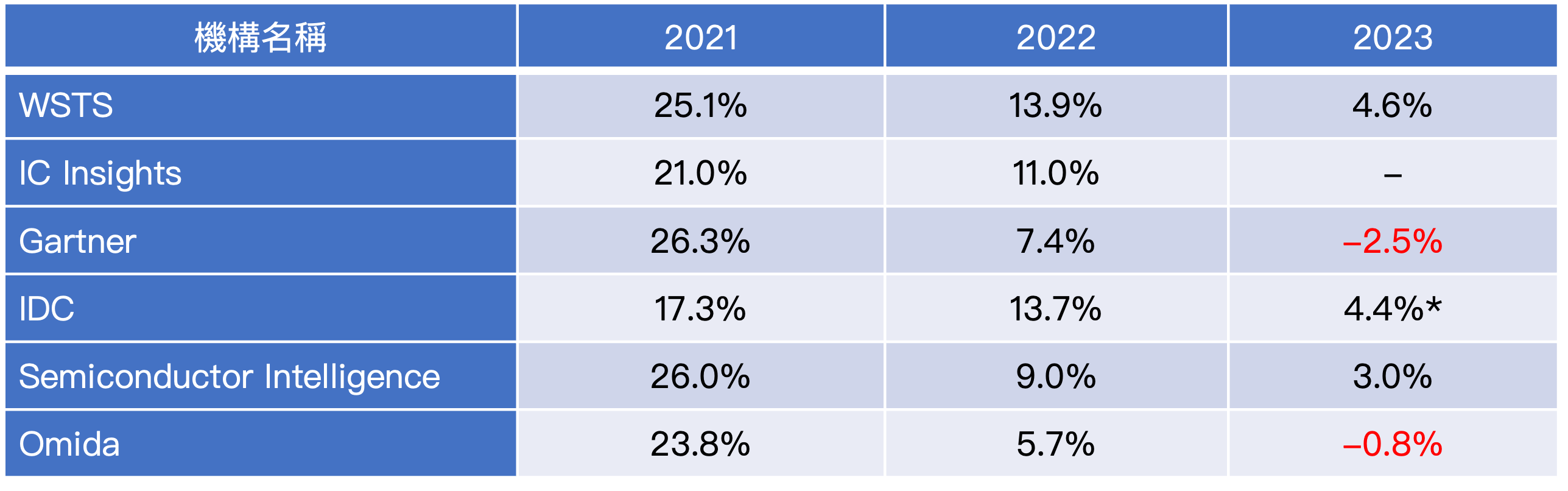
如前面所敘,近幾年晶片缺貨造成嚴重的重複下單情況,使得目前半導體庫存來到歷史新高,加上通貨膨脹蔓延全球導致物價高漲,讓民眾縮減消費支出,不利於半導體後市發展,已有不少機構提出2023年全球半導體市場與產業展望,如表1所列,最悲觀的Gartner預估會衰退2.5%。
表1. 2021、2022、2023年全球半導體市場與產業成長率預估
資料來源 : 智璞產業趨勢研究所整理(*2022.06發布)
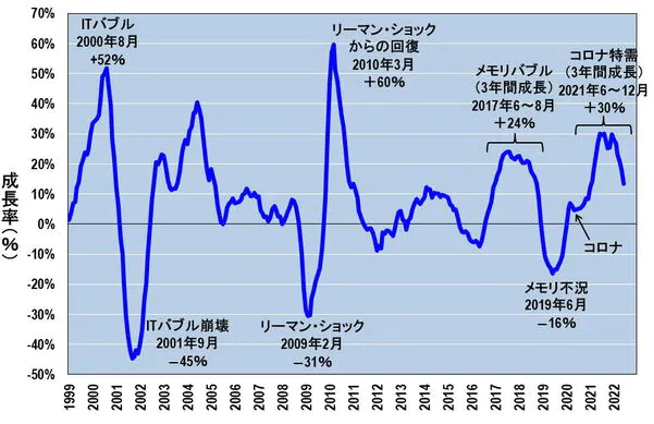
日本微細加工研究所長湯之上隆根據每三個月平均增長率變化來分析全球半導體市場發展趨勢,約莫3~5年會出現成長率劇烈反轉的情況,稱為「矽週期」,如圖2所示。例如全球半導體市場在2000年8月達到52%的成長率,之後因為IT泡沫破裂而衰退之-45%;2008年9月雷曼兄弟公司破產引發金融風暴,讓半導體市場成長率在2009年2月大跌至-31%,一年後於2010年3月增長到60%。因為COVID-19疫情引發的宅經濟需求,讓全球半導體市場自2019年7月起維持連續三年成長期,2021下半年還超過30%,不過2022年1月後增長率開始下降,預估最快於2022年底、最慢於2023年初就會陷入衰退,所幸根據以往經驗衰退期約一年結束,故在2024~2025年應可恢復成長。
圖2、1999~2022年「矽週期」變化趨勢
資料來源 : 電子工程專輯雜誌
下一篇:Industry Trend Report | 全球半導體2022年回顧與2023年展望 (center)
-For more information, please clickContact Us -
 Industry Trend Report|Global Semiconductor 2022 Review and 2023 Outlook (Chinese)
 Presentations | Global Climate and Industry Trend Forecast 2023