Corporate News|FSMC 2025 Q4 Press Conference
TSMC 2025 Q4 Presentation and Commentary
TSMC held a Q4 2025 press conference yesterday, and expects this year to be a year of strong growth. This year's capital expenditures are expected to reach $52 billion to $56 billion, and it is estimated that capital expenditures will remain high for the next three years. Chairman Chieh-Chia Wei pointed out that TSMC is accelerating the expansion of its Arizona plant in the U.S., and that the second plant will enter mass production in the second half of 2027, among other things.
Highlights of TSMC's Q4 Financial Results
- Single-quarter revenue of ~NT$1.09B, QoQ +5.7%, YoY +20.5%
- Gross margin 3%, QoQ +2.8, YoY +3.3
- Business Interest Rate 0%, QoQ +3.4, YoY +5.0
- After-tax net income of approximately NT$400 million, QoQ +11.8%, YoY +35.0%
- EPS (Earnings Per Share) : NT$50, QoQ +11.8%, YoY +35.0%
TSMC continues to outperform the foundry industry for the full year 2025. Revenues increased 35.91 TP3T to US$122.0 billion in USD and 31.61 TP3T to NT$3.8 trillion in NT$. Gross margin for the year increased by 3.8 percentage points to 59.9%, and earnings per share (EPS) for the year increased by 46.4% to NT$66.25.
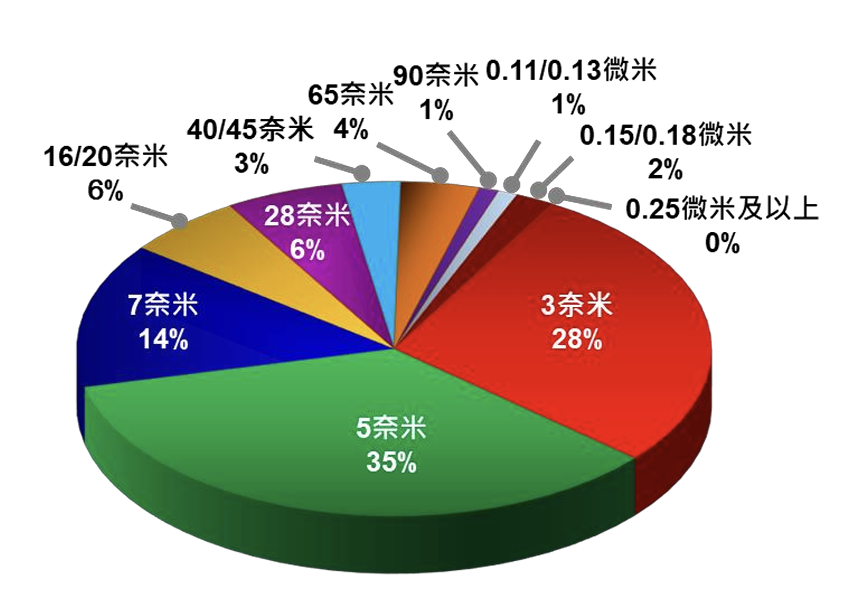
2025Q4 Process Revenue Share
Shipments of 3nm process accounted for 28%, 5nm for 35%, and 7nm for 14% of the overall sales, while advanced processes (7nm and above) accounted for 77%.
TSMC 2025 Q4 Revenue Share
Source : TSMC
2026Annual capital expenditures are estimated to be in the range of $52 billion to $56 billion.
TSMC's outlook for the first quarter of this year shows strong confidence for the start of 2026, with consolidated revenue estimated to be in the range of US$34.6B to US$35.8B. Gross margin is estimated to be between 63% and 65%, while operating profit margin is estimated to be between 54% and 56%, if converted to NT$31.6 per US dollar. For capital expenditures, 2025 expenditures are US$40.9 billion, up from US$29.8 billion in the prior year, and the 2026 capital budget is expected to be in the range of US$52.0 billion to US$56.0 billion for continued investment to support customer growth.
2026Strong Growth Estimated Full Year Dollar Revenue Increase by 30
As we enter 2026, there are uncertainties and risks in the market, including the potential impact of tariff policies and rising component costs, especially in consumer-related and price-sensitive end-market segments," said Mr. Wei. As a result, TSMC remains prudent in our business planning while focusing on business fundamentals to further strengthen our competitive position.
TSMC forecasts that the foundry industry will achieve an annual growth of 14% this year, supported by strong AI demand. With strong demand for leading-edge manufacturing processes, special processes and advanced packaging technologies, TSMC is confident that it will continue to lead the industry in growth. It is predicted that the annual dollar revenue growth will be close to 30%.
Two Nanometer Advanced Process Technology
The 2nm process has already entered mass production in the second half of 2025 in Hsinchu and Kaohsiung simultaneously, and the current yield performance is very good, while the volume release will be accelerated in 2026. Mr. Wei said that N2, N2P and A16 and their derivatives will make the 2nm family another large-scale, long-life cycle process generation. N2P will be further optimized in terms of performance and power consumption, and will begin volume production in the second half of 2026. Also in volume production in the second half of 2026 will be the A16 back-side power technology for high-performance computing for HPC products with complex signal paths and dense power supply.
Overseas Production Expansion Progress
Capacity expansion in Arizona, U.S.A., with the first one already in production in the second half of 2024. The second fab is expected to move in in 2026 and production will be advanced to the second half of 2027. A third wafer fab has begun construction, a fourth wafer fab and the first advanced packaging facility are in the process of applying for permits, and the acquisition of adjacent land has been completed to address long-term AI demand.
In Japan, the first fab in Kumamoto will be in mass production by the end of 2024 with good yields, and the construction of the second fab has already begun, with the actual process and mass production schedule to be adjusted according to customer demand and market conditions.
The special process plants in Europe and Dresden, Germany will progress according to plan and focus on automotive and industrial applications.
However, Taiwan is still an important investment base for advanced processes, and the 2nm capacity in Hsinchu and Kaohsiung will be expanded in phases.
Ji-Pu's point of view.
Looking forward to 2026, TSMC's revenue structure will begin to incorporate the contribution of 2nm in real terms. However, at the initial stage of new process volume release, yields are still climbing, coupled with the high depreciation and cost structure of new-generation equipment, exerting certain pressure on gross margins in the short term, which is a typical phenomenon of advanced process generation changeover.
The most important aspect of this law is that the capital expenditure guidance for 2026 is a record high of US$52-56 billion, and will likely continue to expand at this level for the next three years. Among them, about 70 to 80% are clearly invested in advanced manufacturing processes. In contrast, although advanced packaging is still an important investment direction, the relative proportion of its capital allocation has not been enlarged at the same time, and on the contrary, it has been diluted in the overall CAPEX structure. This indicates that the core focus of this round of production expansion is still on process capacity rather than the full internalization of packaging capabilities.
Another market change of note is that TSMC is structurally adjusting its resource allocation for mature processes. The company has explicitly mentioned that some 8" and 12" capacity is being optimized and redirected to support high-value processes and advanced packaging needs. Such adjustments are not only a response to the short-term cycle, but also reflect a change in long-term strategic direction. In the future, we do not rule out the possibility of continuing to reduce the proportion of mature processes (less than 28nm), or even cut out completely.
Overall, the signals from this presentation are very clear: the Chairman has emphasized the true nature of AI demand, and TSMC has viewed AI and high-performance computing as structural long-term needs, and has re-adjusted its capital allocation, capacity structure, and technology routes accordingly.
 Jan W4|Big Health News Highlight: Ropeg's New Indications Recognized by NCCN, Yoho Pharmaceuticals ET Takes Another Step Toward the U.S. Market