October_Silicon Photonics Co-packaging|Global Co-packaging Optical Technology Development Overview(Up)
So far, traditional pluggable optical modules have been developed in GBIC, SFP, XFP, QSFP, CFP, OSFP, etc. GBIC is an interchangeable product that meets international standards and can be used as a pluggable adapter, which was the most popular optical module packaging technology before 2000, and then it was replaced by the smaller SFP; the size of the SFP is reduced by half compared to the GBIC, but it can be configured with more than double the number of ports, and the transmission speed covers 1.25/2.5/6Gbps, and the upgraded versions such as SFP+, SFP28, and SFP56 have been introduced. SFP is half the size of GBIC but can be configured to more than double the number of ports, the transmission speed covers 1.25/2.5/6Gbps, and then launched SFP+, SFP28, SFP56 and other upgraded versions, respectively, to support 10, 25, 50Gbps transmission speed; XFP appeared in the SFP + before the transmission rate can also reach 10Gbps; QSFP can support 4-channel transmission, so the transmission rate is four times as high as 40Gbps; QSFP can support 4-channel transmission, so the transmission rate is four times as high as SFP+ and can be up to 40Gbps. QSFP can support 4-channel transmission, so the transmission rate is four times that of SFP and can reach 40Gbps, but the volume is only 30% larger than SFP, and later developed QSFP28, QSFP56, QSFP-DD and other upgraded versions, which can support 100, 200, and 400Gbps transmission speeds; CFP is the packaged form developed for 100 Gigabit Ethernet, with a transmission rate of 40/100 Gbps, and later also developed CFP. CFP is a package developed for 100 Gigabit Ethernet with 40/100 Gbps transmission rate. CFP2, CFP4, CFP8 and other upgraded versions were developed later. CFP2 and CFP4 are 1/2 and 1/4 smaller in size, CFP8 is the same size as CFP2, and it realizes 400 Gbps transmission rate through 16 25 Gbps or 8 50 Gbps interfaces; OSFP is the most recent package, which supports 8-channel transmission and reaches 400 Gbps transmission rate. OSFP is the latest package to support 8-channel transmission to achieve 400Gbps, and is smaller than CFP8 but slightly larger than QSFP-DD.
共封裝光學的構型與可插拔光模組完全不同,它是以矽光子晶片取代可插拔光模組,並與交換器晶片封裝在單一載板上。目前發展技術分為2.5D與3D等兩種型式。2.5D封裝是將矽光子與交換器晶片鍵合在單一載板上,其優勢是載板面積大可放置多顆晶片以整合更多功能,但缺點是晶片間互聯信號傳輸路徑較長而導致速度較慢,預估適用於100Tbps以下之應用。3D封裝是將矽光子晶片直接堆疊在交換器晶片上,其優點是傳輸路徑較短而使得資料傳送速度較快,缺點是交換機晶片產生的高熱會傳遞到矽光子晶片而造成其處理效能下降。2023年多位業界專家共同發布論文「Silicon Photonics – Roadmapping the Next Generation」,針對四種的2.5D與3D共封裝光學形式提出特性比較如表1所列,2.5D封裝的矽光子、交換器晶片互聯方式包括a.打線連接、b.藉由凸塊與載板線路連接,3D封裝則包含透過c.矽穿孔(TSV)或d.氧化層穿孔(TOV)直接連接,如圖2所示。2.5D技術比較成熟且已商業化,3D技術的電信號以垂直方向傳輸,所以寄生參數更小而支援更高的信號傳輸速率,此外TSV/TOV還可解決大晶片的供電問題。
圖2、四種2.5D與3D共封裝光學形式示意圖
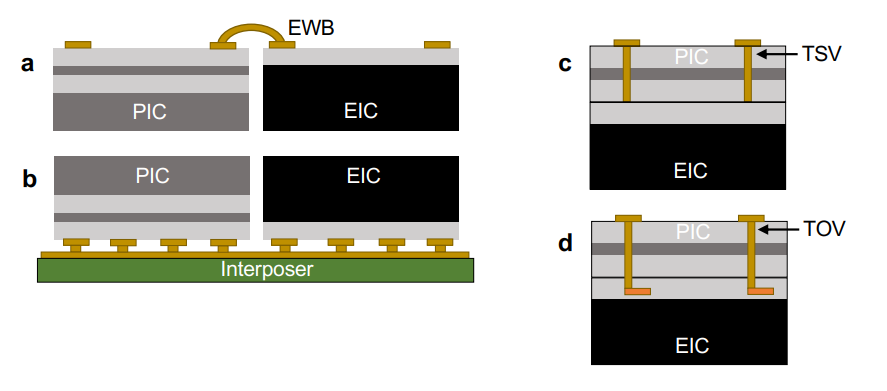
資料來源 : Physics Optics (2023)
表1、四種2.5D與3D共封裝光學形式的特性比較
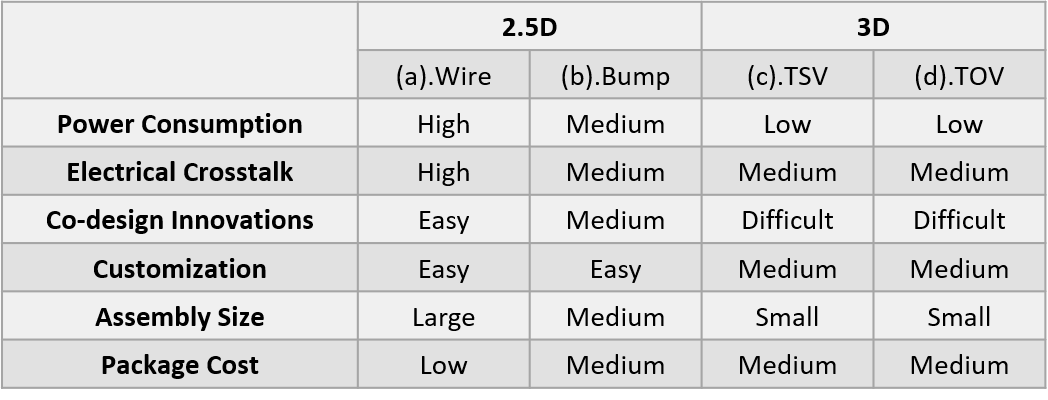
資料來源 : Physics Optics (2023); 智璞產業趨勢研究所整理,2023/10
 October_Silicon Photonics Co-packaging|Taiwan Co-packaging Optics Industry Development Overview
 October_Silicon Photonics Co-packaging|Global Co-packaging Optical Technology Development Overview(Next)