October_Silicon Photonics Co-packaging|Global Co-packaging Optical Technology Development Overview(Next)
Currently, most of the optical signal inputs and outputs in co-packaged optics use edge couplers. The use of V-slot can simultaneously reduce the alignment error and transmission loss requirements, so that the signal loss from the optical fiber to the silicon photonics chip is controlled within -1.5 dB, and the use of thermal phase shifters can further improve the alignment accuracy. In addition, since the performance of some of the optical components in the silicon photonics chip is highly susceptible to the high temperature variations generated by the switch chip, co-packaged optical modules are usually cooled by either air or liquid cooling devices, the latter of which has a better cooling effect due to its low operating noise, even heat dissipation, and the lack of an additional power supply for the fan. Intel's liquid cooling solution can reduce the temperature of co-packaged optical modules by 35°C.
圖3、六種共封裝光學使用光源形式示意圖
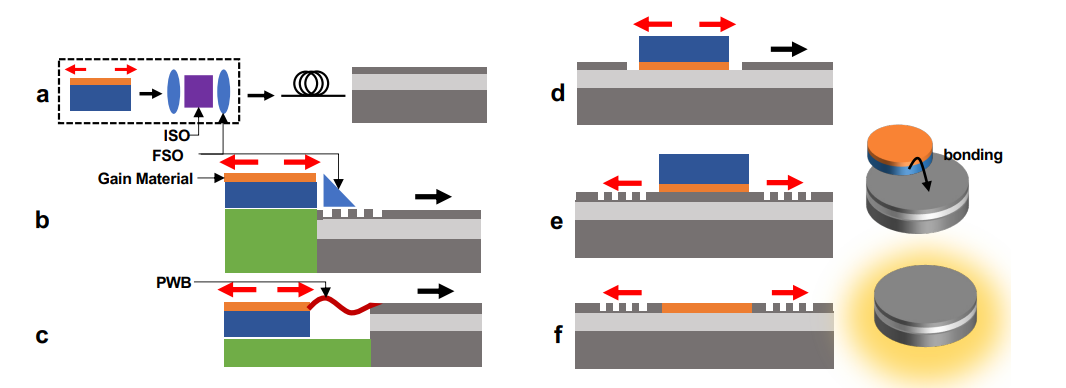
資料來源 : Physics Optics (2023)
表2、六種共封裝光學使用光源形式的特性比較
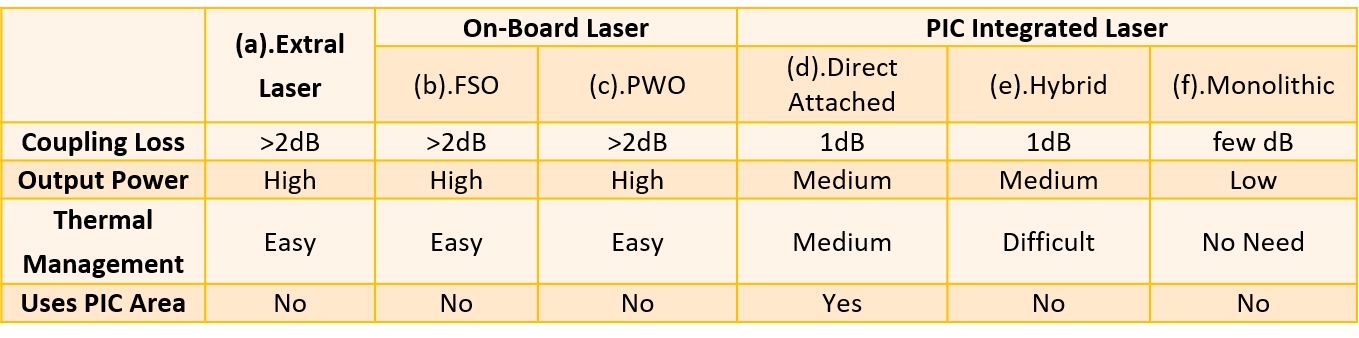
資料來源 : Physics Optics (2023)
模擬設計軟體對共封裝光學的大規模商業化應用十分重要,目前光子設計自動工具(PDA)主要用於光學元件模擬,其運算效率很低,不適合共封裝光學模擬。開發矽晶片用的電子設計自動工具(EDA)反而可應用在大規模電子與光子協同運作模擬,故比較適用共封裝光學設計。目前已有許多軟體廠商推出相關產品,例如Synopsys推出的套裝軟體包括用於模擬光學元件的Sentaurus或Rsoft、光學系統的OptSim或ModeSYS,若需要電子與光子協同運作模擬則使用OptSim與 PrimeSim HSPICE.;Ansys推出光子模擬軟體Ansys Lumerical,內含微奈米光學設計環境FDTD、波導設計環境MODE、電荷傳輸環境CHARGE 3D、光電磁環境GDTD、量子力學環境MQW、光學模擬環境STACK等功能。
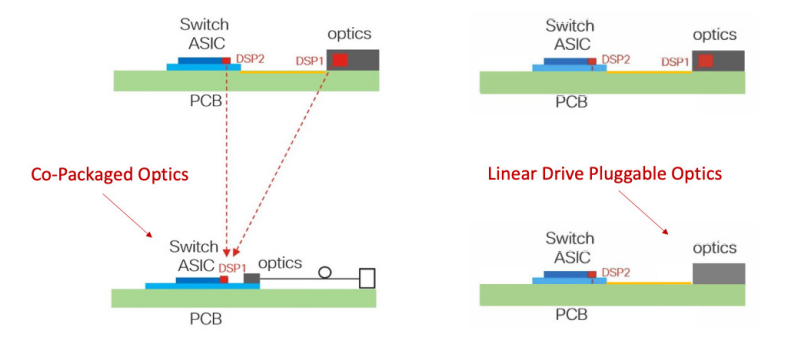
因為共封裝光學技術難度高且不易維修,短期難以大規模商業化應用,於是2023年OFC展中部分光模組廠商推出可拔光模組的改良版-線性驅動可插拔光學(Linear-drive Pluggable Optics;LPO)模組,其將光模組的數位訊號處理(DSP)與時脈資料恢復(CDR)晶片功能整合至交換器晶片內,使得光模組中只留下線性度較高的驅動和轉阻放大器(TIA)晶片。相較於可插拔光學模組,其優點是功耗減少約50%、成本下降20~40%、訊號延遲降低到皮秒等級,且因光模組的封裝形式沒有顯著變化,故可沿用現有交換機設備,使系統易於管理和維護,Amazon、Meta、Microsoft、Google等雲端運算服務大廠都對該技術表示興趣。雖然線性驅動可插拔光學發展比共封裝光學晚,但預期大規模商業化應用反而比較快,兩者結構差異如圖4所示,其市場發展關鍵是驅動和轉阻放大器晶片,目前主要供應商有Macom、Semtech、ADI。
圖4、線性驅動可插拔光學與共封裝光學模組結構的差異比較
資料來源 : 2023 OFC Post-Show Report (2023)
 October_Silicon Photonics Co-packaging|Global Co-packaging Optical Technology Development Overview(Up)
 November_FPGA Topics|FPGA History and Product Positioning